
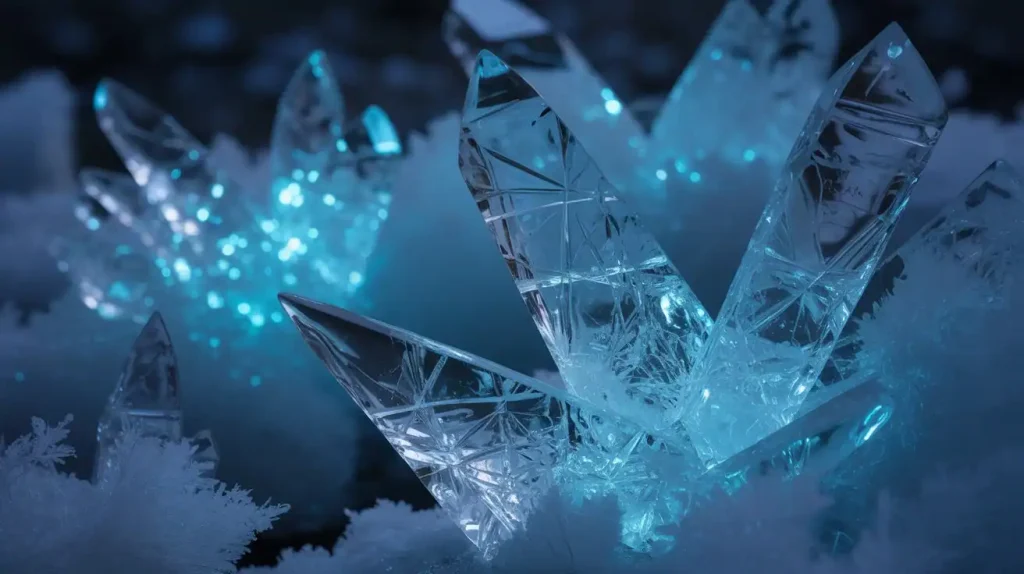
Ice may seem simple, but it holds a world of unusual properties and hidden surprises. From its strange behavior in nature to its role in science, ice is far more fascinating than it appears. These facts reveal just how mysterious frozen water can be.
The Science Behind Ice
- Ice expands when it freezes, unlike most substances that contract.
- Because of this expansion, ice is less dense than water and floats.
- Ice can exist in more than 18 different crystalline forms under extreme conditions.
- The common ice we see is known as Ice Ih, a hexagonal structure.
- Ice is actually a mineral, as it is naturally occurring and has a defined structure.
- Frozen water can trap air bubbles, preserving tiny samples of ancient atmospheres.
- Ice conducts heat poorly, making it an effective insulator.
- Under pressure, ice can melt even below its normal freezing point.
Ice in Nature
- Glaciers store about 69 percent of the world’s freshwater.
- Icebergs are mostly hidden underwater, with only about 10 percent visible above the surface.
- Snowflakes are all unique due to slight variations in temperature and humidity.
- Some fish produce natural antifreeze proteins to survive in icy waters.
- Ice caves can glow blue due to the way light is absorbed and scattered.
- Frozen lakes can make eerie sounds as ice expands and contracts.
- Permafrost can preserve plants and animals for thousands of years.
Strange and Unexpected Ice Facts
- Hot water can freeze faster than cold water in certain conditions, known as the Mpemba effect.
- Ice can burn if exposed to a strong enough flame and oxygen source.
- It is possible to boil water and freeze it at the same time under specific pressure conditions.
- Ice is slippery not just because it melts, but also due to a thin liquid-like layer on its surface.
- Some planets and moons have ice made of methane or ammonia instead of water.
- There is such a thing as “dry ice,” which is frozen carbon dioxide, not water.
- Ice can slowly flow over time, behaving like a very thick liquid in glaciers.
- Under extreme pressure, ice can become hot enough to melt while still remaining solid in structure.
Ice is far more than frozen water; it is a substance full of scientific mysteries and natural wonders. From its unusual physical properties to its surprising behaviors, ice continues to intrigue researchers and observers alike. Looking closer at something so common reveals just how extraordinary it truly is.