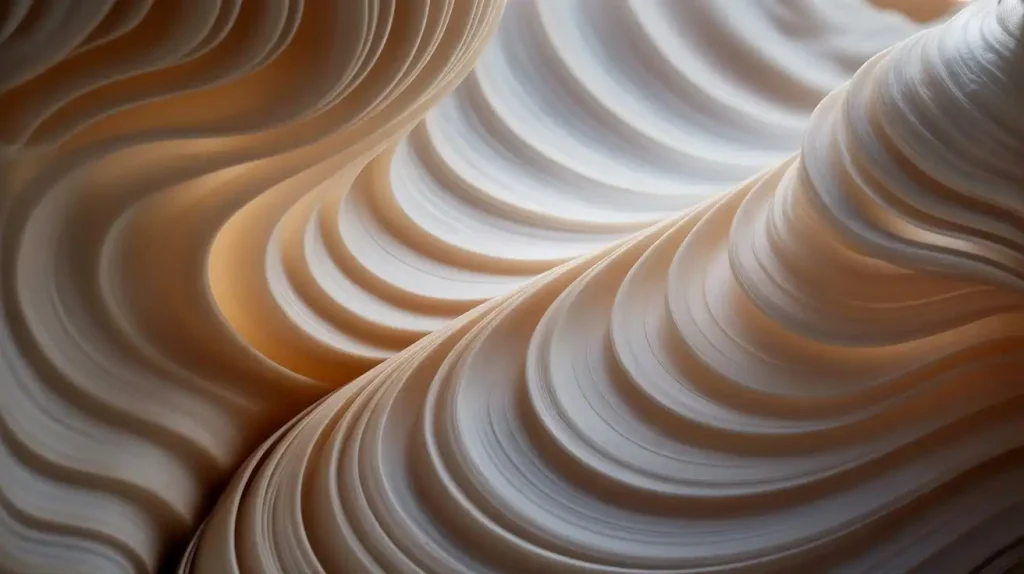
Curves appear throughout nature, from the shape of galaxies to the smallest living organisms. They often emerge from simple rules yet create complex and beautiful forms. Understanding these natural curves reveals hidden patterns that connect mathematics, physics, and life itself.
Curves in Natural Forms
- Many plant tendrils grow in spirals to support climbing and stability.
- Leaves often display curved edges that help maximize sunlight exposure.
- Shells commonly form logarithmic spirals that maintain their shape as they grow.
- Rivers carve winding curves as water follows the path of least resistance.
- Sand dunes form smooth curves shaped by wind and shifting grains.
Mathematical Curves in Nature
- The Fibonacci sequence appears in spiral patterns found in flowers and pinecones.
- Logarithmic spirals maintain consistent proportions regardless of size.
- Fractal curves repeat similar shapes at different scales.
- Wave patterns form curved shapes based on energy movement.
- Natural curves often result from optimization processes in physics.
Curves in Motion
- Planets follow curved paths as they orbit stars.
- Projectiles travel in curved trajectories due to gravity.
- Ocean waves rise and fall in repeating curved forms.
- Smoke rises in curling, unpredictable curves.
- Animal movement often follows curved paths rather than straight lines.
Unexpected Curved Phenomena
- Lightning travels in jagged yet subtly curved paths through the air.
- Tree branches curve toward light in a process known as phototropism.
- Clouds form soft, rounded curves influenced by air currents.
- Curved surfaces can strengthen structures by distributing stress.
- Raindrops appear curved due to surface tension shaping their form.
Curves and Perception
- The human eye is naturally drawn to curves more than straight lines.
- Curved shapes often feel more organic and natural than rigid forms.
- Perspective can make straight lines appear curved at a distance.
- Curves help the brain recognize patterns and continuity in nature.
- Many natural curves balance efficiency, strength, and growth.
Conclusion
Curves in nature are more than just visual features; they are the result of underlying principles that govern growth, motion, and structure. From spirals to waves, they reveal a deep connection between mathematics and the natural world. Observing these curves offers a new appreciation for the elegance hidden in everyday forms.