
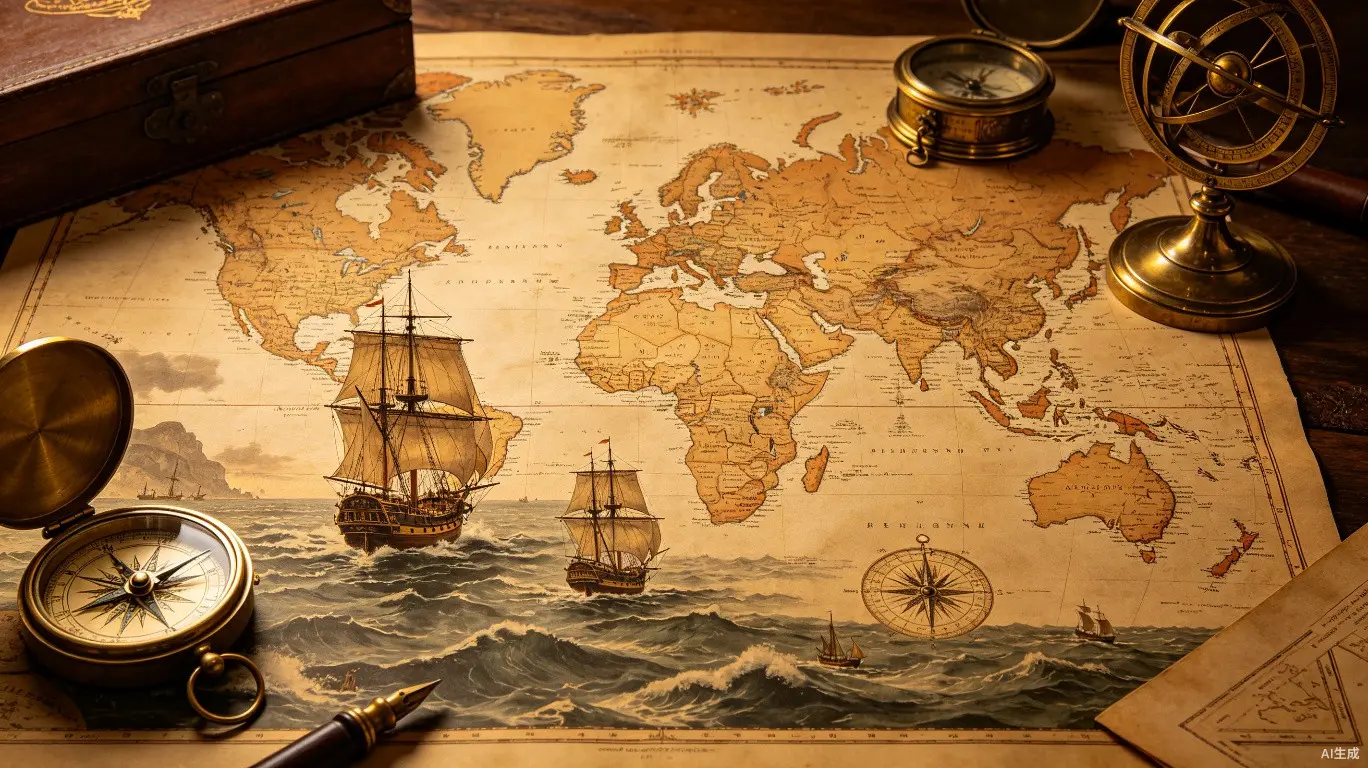
The Age of Exploration between the 15th and 17th centuries reshaped the world map and connected hemispheres that had been isolated for millennia. These voyages brought profound discoveries that transformed science, trade, culture, and the global balance of power.
When Christopher Columbus set sail in 1492, most educated Europeans already knew the Earth was spherical -- the myth that they believed in a flat Earth was invented by Washington Irving in his 1828 biography of Columbus. The real debate was about the Earth's circumference. Columbus dramatically underestimated the distance to Asia, calculating it at roughly one-quarter of the actual 19,000-kilometer westward journey to Japan. Had the Americas not existed, Columbus and his crew would have perished at sea.
Ferdinand Magellan's expedition (1519-1522) became the first to circumnavigate the globe, but Magellan himself did not survive the journey. He was killed in the Philippines in 1521 during a battle with local warriors. Of the five ships and approximately 270 men who departed, only one ship -- the Victoria -- and 18 crew members returned to Spain under the command of Juan Sebastian Elcano.
The Columbian Exchange -- the transfer of plants, animals, diseases, and people between the Old and New Worlds -- represents the single most transformative biological event since the end of the last ice age. Potatoes, tomatoes, maize, chocolate, and tobacco traveled east; wheat, rice, coffee, horses, cattle, and devastating diseases traveled west. It is estimated that Old World diseases killed 80% to 90% of the indigenous population of the Americas within the first century of contact.
The Portuguese explorer Bartolomeu Dias became the first European to sail around the southern tip of Africa in 1488, opening the sea route to the Indian Ocean. Dias originally named it the "Cape of Storms" due to the treacherous weather he encountered. King John II of Portugal renamed it the "Cape of Good Hope" for the optimistic trade prospects the route offered to India and beyond.
Vasco da Gama's voyage to India (1497-1499) covered approximately 38,000 kilometers -- roughly the circumference of the Earth -- and was the longest ocean voyage in history to that point. His arrival in Calicut established the first direct sea link between Europe and India, breaking the overland spice trade monopoly long controlled by Arab and Venetian middlemen and fundamentally shifting the economic center of gravity toward Atlantic Europe.
The Spanish silver trade from the mines of Potosi in modern Bolivia and Zacatecas in Mexico flooded the global economy with an estimated 150,000 tons of silver between 1500 and 1800. Much of this silver flowed to China, which had adopted silver as its primary currency, creating the first truly global economic system. The influx was so massive that it caused severe inflation in Spain and contributed to what historians call the "Price Revolution" across 16th-century Europe.
Zheng He, a Chinese admiral of the Ming Dynasty, commanded treasure fleets of up to 317 ships and 28,000 men that explored the Indian Ocean between 1405 and 1433 -- decades before Columbus. Zheng He's flagship was estimated at 127 meters long, compared to Columbus's Santa Maria at just 19 meters. Had China not abruptly ended these expeditions and turned inward, the Age of Exploration might have been dominated by the East rather than the West.
The invention of the caravel -- a small, highly maneuverable ship with lateen (triangular) sails -- was the technological breakthrough that made the Age of Exploration possible. Developed by the Portuguese in the 15th century, caravels could sail closer to the wind than any previous vessel, enabling them to navigate the contrary winds and currents along the African coast that had defeated earlier attempts to sail south.
The Treaty of Tordesillas (1494), brokered by Pope Alexander VI, divided the entire non-European world between Spain and Portugal along a meridian 370 leagues west of the Cape Verde islands. This gave Portugal claim to Brazil (then unknown to Europeans), while Spain received the rest of the Americas. The treaty, which completely ignored the existence and sovereignty of indigenous peoples, shaped the linguistic and cultural map of South America that persists to this day.
Captain James Cook's three voyages between 1768 and 1779 mapped vast areas of the Pacific Ocean previously unknown to Europeans, including the eastern coastline of Australia, New Zealand, and Hawaii. Cook was the first European to cross the Antarctic Circle and his crew included scientists who collected thousands of botanical and zoological specimens. His use of citrus fruits to prevent scurvy -- though the mechanism of vitamin C was not yet understood -- saved countless lives.
The search for the Northwest Passage -- a sea route through the Arctic connecting the Atlantic and Pacific oceans -- drove centuries of exploration and claimed hundreds of lives. The passage was finally navigated by Roald Amundsen between 1903 and 1906, but it was not until 2009 that the first commercial ship transited the route, made possible by the retreat of Arctic sea ice due to climate change -- an ironic conclusion to a quest that began with 15th-century explorers seeking a shorter route to Asia.
Abel Tasman, a Dutch explorer, was the first European to sight New Zealand (1642) and Tasmania (which he named Van Diemen's Land after his patron). His encounters with the indigenous Maori of New Zealand were marked by violence on both sides, and his expedition left without ever setting foot on land. It would be 127 years before James Cook made the next recorded European contact with New Zealand.