
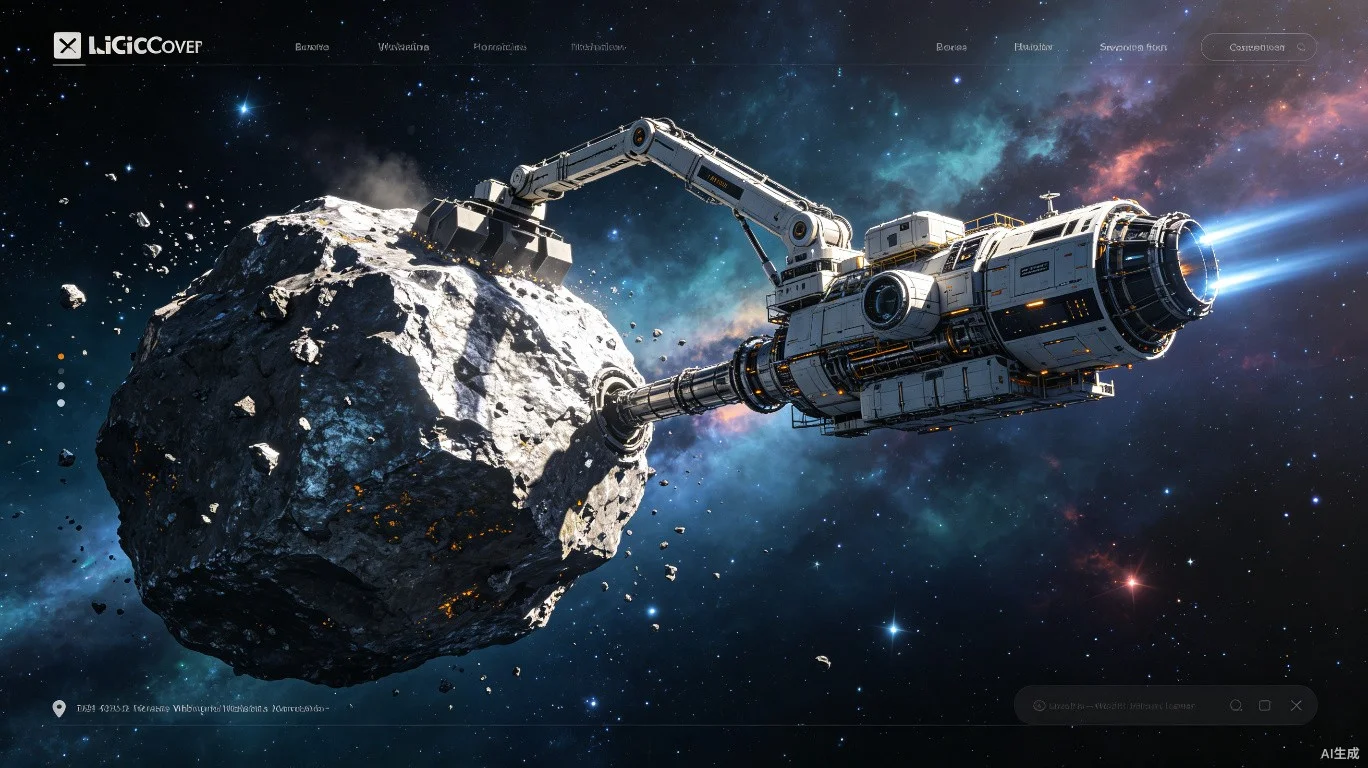
Asteroid mining could transform the global economy by providing virtually unlimited access to precious metals, rare minerals, and water in space.
The asteroid belt between Mars and Jupiter contains an estimated $700 quintillion worth of mineral resources, based on current market prices for platinum-group metals, iron, nickel, and water. The asteroid 16 Psyche alone is estimated to contain $10,000 quadrillion worth of iron and nickel, enough to supply Earth's current metal consumption for millions of years.
Water is considered the most valuable resource for asteroid mining in the near term, not precious metals. Water can be split into hydrogen and oxygen to create rocket fuel, enabling spacecraft to refuel in space rather than carrying all propellant from Earth. A single water-rich asteroid could supply enough fuel to power an entire fleet of spacecraft for decades.
NASA's OSIRIS-REx mission successfully collected samples from the carbon-rich asteroid Bennu and returned them to Earth in September 2023. Analysis of the 121.6 grams of returned material revealed water-bearing clay minerals, organic compounds including amino acids, and phosphates — demonstrating that asteroids delivered the building blocks of life to early Earth.
NASA launched the Psyche mission in October 2023 to explore 16 Psyche, a unique metal-rich asteroid thought to be the exposed nickel-iron core of an early planetesimal — essentially a naked planetary core. The spacecraft will arrive at Psyche in 2029 and spend 26 months orbiting and studying this unprecedented object, which cannot be examined by any other means.
Private companies are leading the asteroid mining race. AstroForge, founded in 2022, became the first private company to receive a license for a deep-space commercial mission. In 2023, it launched its Brokkr-1 spacecraft to test asteroid prospecting technology. AstroForge plans to send a mission to rendezvous with a near-Earth asteroid by 2026 to assess its platinum-group metal content.
Near-Earth asteroids are the most accessible targets for mining due to their proximity and low delta-v requirements. Over 30,000 near-Earth asteroids have been catalogued, and approximately 1,500 of these require less energy to reach than landing on the Moon. Some asteroids pass closer to Earth than our own Moon, making them reachable with existing rocket technology.
The economics of asteroid mining depend heavily on whether resources are brought back to Earth or used in space. Returning platinum-group metals to Earth could be economically viable at current prices ($900-1,100 per ounce for platinum), but only if launch costs continue their current downward trajectory. Using space resources in space — a concept called in-situ resource utilization — is the more immediate economic driver.
Asteroids are broadly classified into three types: C-type (carbonaceous, rich in water and organic compounds), S-type (silicaceous, rich in iron, nickel, and magnesium silicates), and M-type (metallic, rich in iron, nickel, and platinum-group metals). Each type requires different extraction technologies, and the first mining missions will need to precisely characterize a target asteroid's composition before attempting extraction.
Space law governing asteroid mining remains ambiguous. The 1967 Outer Space Treaty prohibits nations from claiming sovereignty over celestial bodies, but does not explicitly address private resource extraction. The US Commercial Space Launch Competitiveness Act of 2015 and similar legislation in Luxembourg and the UAE grant companies the right to own and sell resources extracted from asteroids, though these laws are not universally recognized.
The technical challenges of asteroid mining are formidable. Asteroids have negligible gravity, making it difficult to anchor equipment. Many are loose rubble piles rather than solid bodies. Extracting and processing materials in vacuum and microgravity requires technologies that do not yet exist at scale. However, advances in autonomous robotics, AI, and in-space manufacturing are incrementally addressing these challenges.
Asteroid mining could fundamentally alter Earth's resource economy. If rare platinum-group metals became abundant, their prices would plummet, potentially making technologies like hydrogen fuel cells dramatically cheaper. However, this abundance could also devastate Earth-based mining industries and the economies that depend on them, creating complex geopolitical challenges long before the first asteroid mining mission launches.