
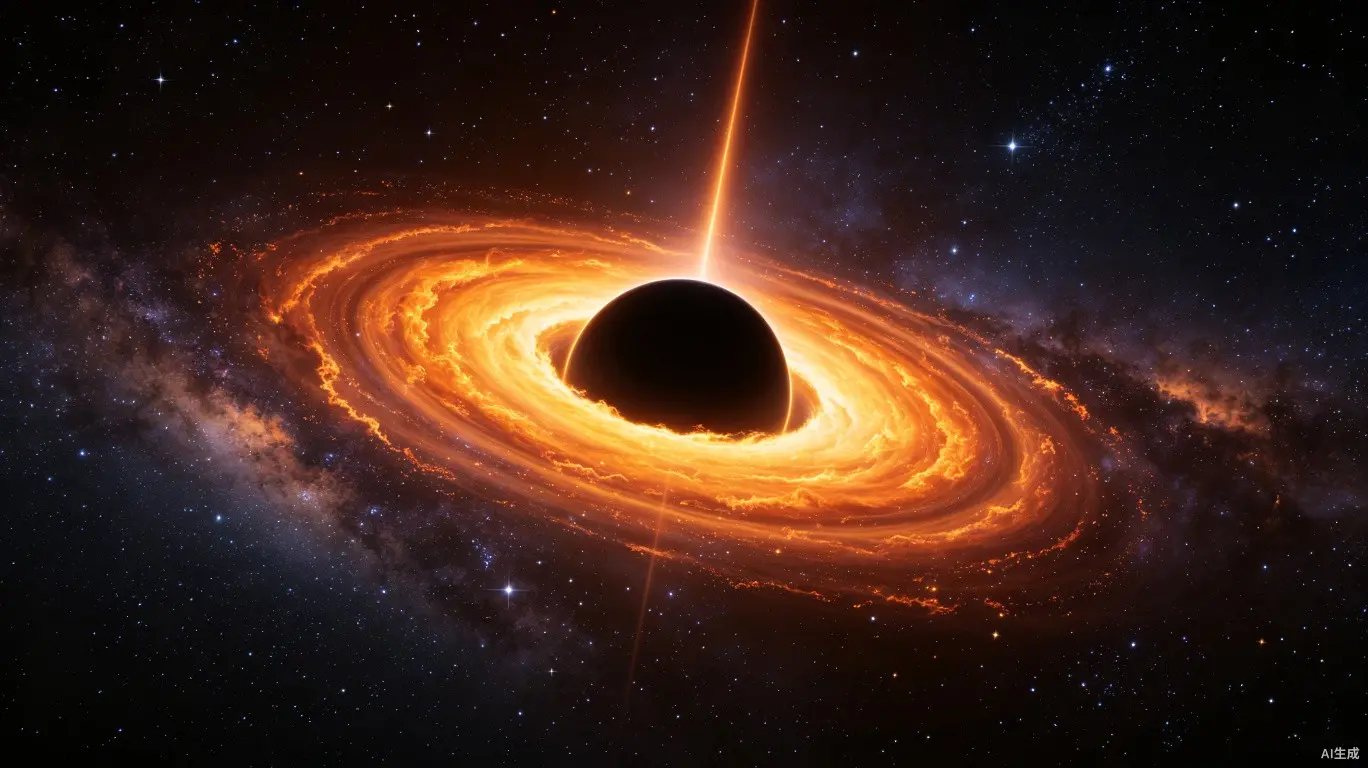
Black holes are the most extreme objects in the known universe -- regions where gravity is so intense that space and time themselves break down. Recent discoveries are revealing new mysteries about their formation, behavior, and their fundamental relationship to the nature of reality.
The first direct image of a black hole, captured by the Event Horizon Telescope and released in April 2019, showed the supermassive black hole at the center of galaxy M87. The image revealed a glowing ring of superheated gas orbiting a central dark region -- the black hole's shadow. The black hole is 6.5 billion times the mass of our Sun, and the ring of light is roughly 100 billion kilometers across.
In 2025, the Event Horizon Telescope team released an even sharper image of Sagittarius A* -- the supermassive black hole at the center of our own Milky Way galaxy. The image revealed previously unseen magnetic field structures spiraling around the black hole's event horizon, structures that closely resemble those around M87's black hole despite the two objects differing in mass by a factor of 1,500, suggesting that strong magnetic fields may be a universal feature of black holes.
The largest known black hole, TON 618, has a mass of approximately 66 billion solar masses -- so enormous that its event horizon would extend well beyond the orbit of Neptune if placed at the center of our solar system. The object is a quasar located about 10.4 billion light-years away, meaning we see it as it existed when the universe was only about 3 billion years old.
Stellar-mass black holes are formed when massive stars exhaust their nuclear fuel and collapse under their own gravity. But a mysterious "mass gap" exists: between the heaviest observed neutron stars (about 2.3 solar masses) and the lightest observed black holes (about 5 solar masses), very few objects have been detected. In 2025, the LIGO-Virgo-KAGRA collaboration detected a compact object of 2.6 solar masses, right in the middle of the gap, potentially resolving a decades-old puzzle about how the most massive neutron stars transition to black holes.
Stephen Hawking's 1974 prediction that black holes emit radiation and slowly evaporate -- now called Hawking radiation -- remains one of the most profound but experimentally unconfirmed predictions in physics. For a stellar-mass black hole, the radiation is so faint it would take far longer than the current age of the universe for the black hole to evaporate. However, in 2025, researchers using analog systems of ultra-cold atoms successfully created "sonic black holes" in the laboratory that emit a measurable analog of Hawking radiation, providing the first experimental evidence that the theoretical mechanism is sound.
The black hole information paradox -- the question of whether information that falls into a black hole is destroyed or preserved -- has been one of the deepest puzzles in theoretical physics for nearly 50 years. In a series of breakthrough calculations from 2019 to 2025, physicists demonstrated that information can be encoded in the radiation emitted by black holes through quantum entanglement effects, a resolution that suggests quantum mechanics and general relativity can be reconciled in ways previously thought impossible.
Primordial black holes, theorized to have formed in the first moments after the Big Bang from the collapse of extreme density fluctuations, could range in mass from microscopic (smaller than an atom) to supermassive. If they exist, they could explain dark matter, seed supermassive black holes, and provide a window into the universe's earliest moments. Ongoing surveys including the Vera C. Rubin Observatory are designed to either detect or rule out a significant population of primordial black holes.
When two black holes merge, the gravitational waves released can carry away up to 5% of the combined mass as pure energy in the form of ripples in spacetime. The first such detection by LIGO in 2015 converted approximately three solar masses of material into gravitational wave energy in a fraction of a second -- briefly outshining all the stars in the observable universe combined in terms of power output.
Spaghettification is the term astrophysicists use for what happens to any object falling into a stellar-mass black hole: the difference in gravitational pull between the part closest to the black hole and the part farthest away stretches the object into a long, thin strand like spaghetti. For a human-sized object approaching a solar-mass black hole, spaghettification would occur well outside the event horizon and be fatal long before reaching the point of no return.
Supermassive black holes at the centers of galaxies appear to be intimately connected to their host galaxies, with the black hole mass typically about 0.1% of the mass of the galaxy's central bulge of stars. This correlation, discovered in the early 2000s, suggests that galaxies and their central black holes co-evolve, with the black hole's energy output (through jets and radiation) regulating star formation throughout the galaxy.
The concept of a wormhole -- a hypothetical tunnel through spacetime connecting two distant points -- emerges from the mathematics of general relativity and is closely related to black hole physics. In 2025, researchers using Google's Sycamore quantum processor successfully simulated a traversable wormhole in a simplified quantum system, providing the first laboratory demonstration that information can be transmitted through a wormhole-like geometry, albeit in a one-dimensional quantum system far simpler than the real universe.
Black holes may ultimately provide the key to a theory of quantum gravity -- the holy grail of modern physics that would unify quantum mechanics and general relativity. The black hole's event horizon, where quantum effects and extreme gravity meet, is the natural laboratory for testing theories of quantum gravity, and each new observation from instruments like the Event Horizon Telescope and gravitational wave detectors brings us closer to understanding how the universe works at its most fundamental level.