
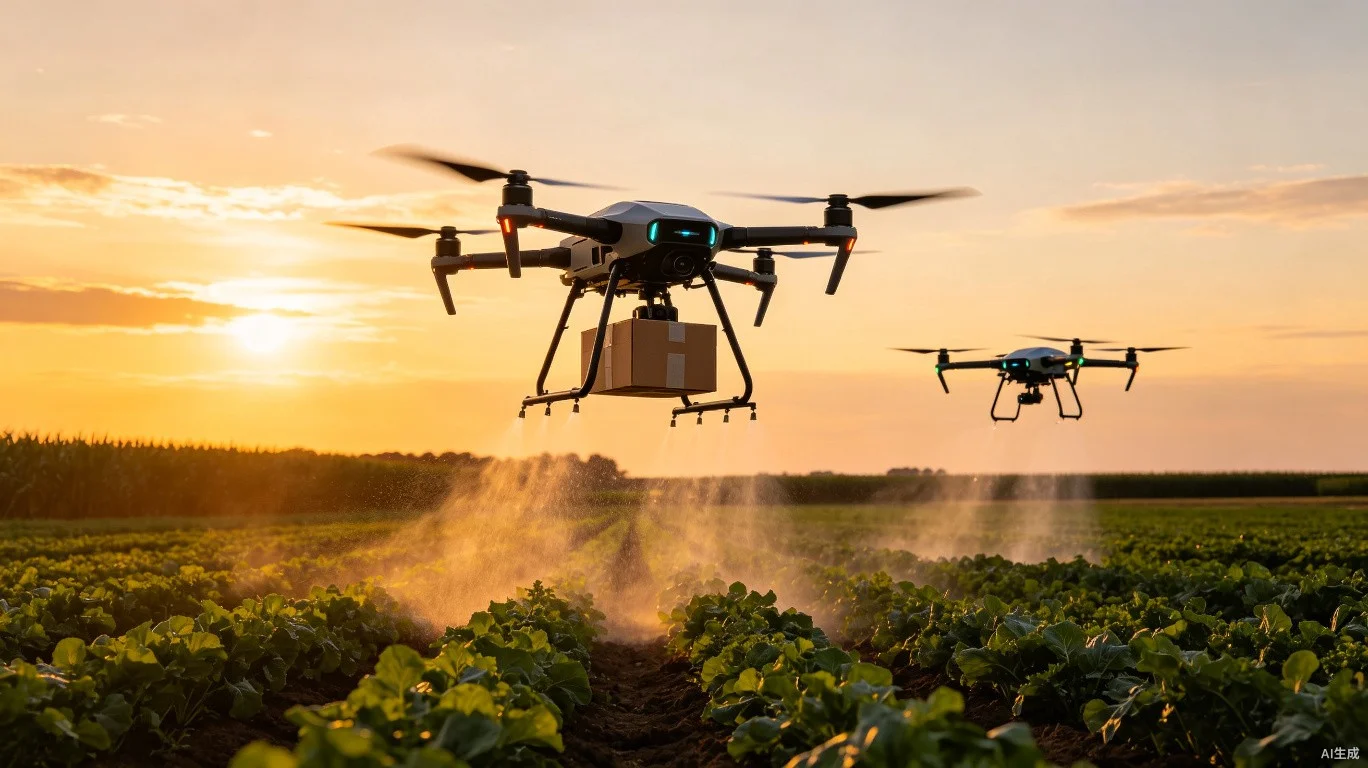
Drone technology has evolved far beyond military applications, transforming industries from agriculture and logistics to filmmaking and disaster response.
The global commercial drone market is projected to exceed $50 billion by 2028, with applications spanning agriculture, construction, logistics, insurance, media, and public safety. The agricultural sector alone accounts for roughly 25% of commercial drone usage, where drones perform crop monitoring, precision spraying, and field mapping.
Agricultural drones equipped with multispectral cameras can detect crop stress, disease, and nutrient deficiencies up to two weeks before they become visible to the human eye. This early detection allows farmers to address problems precisely where needed, reducing pesticide and fertilizer use by 30-50% while improving yields by 10-15%.
Drone delivery is no longer a futuristic concept. Companies like Zipline have completed over 1 million commercial drone deliveries, primarily of medical supplies in Rwanda and Ghana. Zipline's drones can deliver blood, vaccines, and medications to remote clinics within 30 minutes, routes that would take hours or days by road.
Wing (a subsidiary of Alphabet) and Amazon Prime Air have launched drone delivery services in select cities in the US, Australia, and Europe. These services primarily deliver small consumer goods like meals, coffee, and pharmacy items, with delivery times as fast as 5-10 minutes from order placement. Regulatory frameworks for beyond-visual-line-of-sight (BVLOS) operations are being developed to enable wider commercial deployment.
In construction and infrastructure inspection, drones have become essential tools for surveying, progress monitoring, and safety inspections. A drone can complete a roof inspection in 15 minutes that would take an inspector 2-3 hours with ladders, and it can safely inspect bridges, wind turbines, and power lines without putting workers at risk. The construction drone market alone is expected to reach $12 billion by 2027.
Consumer drones have democratized aerial photography and videography. Modern consumer drones like the DJI Mini series weigh under 250 grams, fit in a jacket pocket, and capture 4K video with 3-axis mechanical stabilization. The low barrier to entry has created entirely new genres of content creation, from real estate cinematography to adventure sports documentation.
Drones are playing an increasingly important role in disaster response and search-and-rescue operations. Equipped with thermal cameras, drones can locate missing persons in darkness, dense vegetation, or rubble. During the 2023 Turkey-Syria earthquakes, drones provided critical real-time damage assessment, identified survivors trapped in collapsed buildings, and helped coordinate rescue efforts.
First-person view (FPV) drone racing has become a legitimate sport, with the Drone Racing League broadcasting events to millions of viewers worldwide. FPV pilots wear goggles that receive a live video feed from the drone's camera, experiencing flight as if they were inside the drone. The fastest racing drones can accelerate from 0 to 100 mph in under a second and reach speeds exceeding 120 mph.
Environmental and wildlife monitoring has been revolutionized by drones. Researchers use drones to count endangered species, track migration patterns, and monitor deforestation without disturbing ecosystems. In 2024, drones equipped with seed-dispersal mechanisms were used to reforest remote areas at a rate of 40,000 seeds per day — roughly ten times faster than manual planting.
Swarm technology, where dozens or hundreds of drones operate in coordinated formations, is advancing rapidly. China's EHang has demonstrated drone swarms of over 3,000 units creating animated light shows. Military applications of swarms — coordinating groups of drones for reconnaissance or attack missions — are being developed by multiple nations, raising significant ethical and arms-control concerns.
The integration of artificial intelligence with drones is creating autonomous capabilities that were science fiction a decade ago. AI-powered drones can navigate complex environments without GPS, identify and track objects of interest, and make real-time decisions about flight paths. Autonomous underwater drones (AUVs) and surface maritime drones are similarly transforming ocean exploration, pipeline inspection, and naval operations.
Counter-drone technology has become a parallel growth industry. Airports, stadiums, prisons, and critical infrastructure facilities are deploying systems that detect, identify, and neutralize unauthorized drones using radio frequency jamming, net-capture drones, lasers, and even trained eagles. The 2018 Gatwick Airport drone incident, which shut down the airport for 33 hours and affected 140,000 passengers, highlighted the urgent need for effective counter-drone measures.