
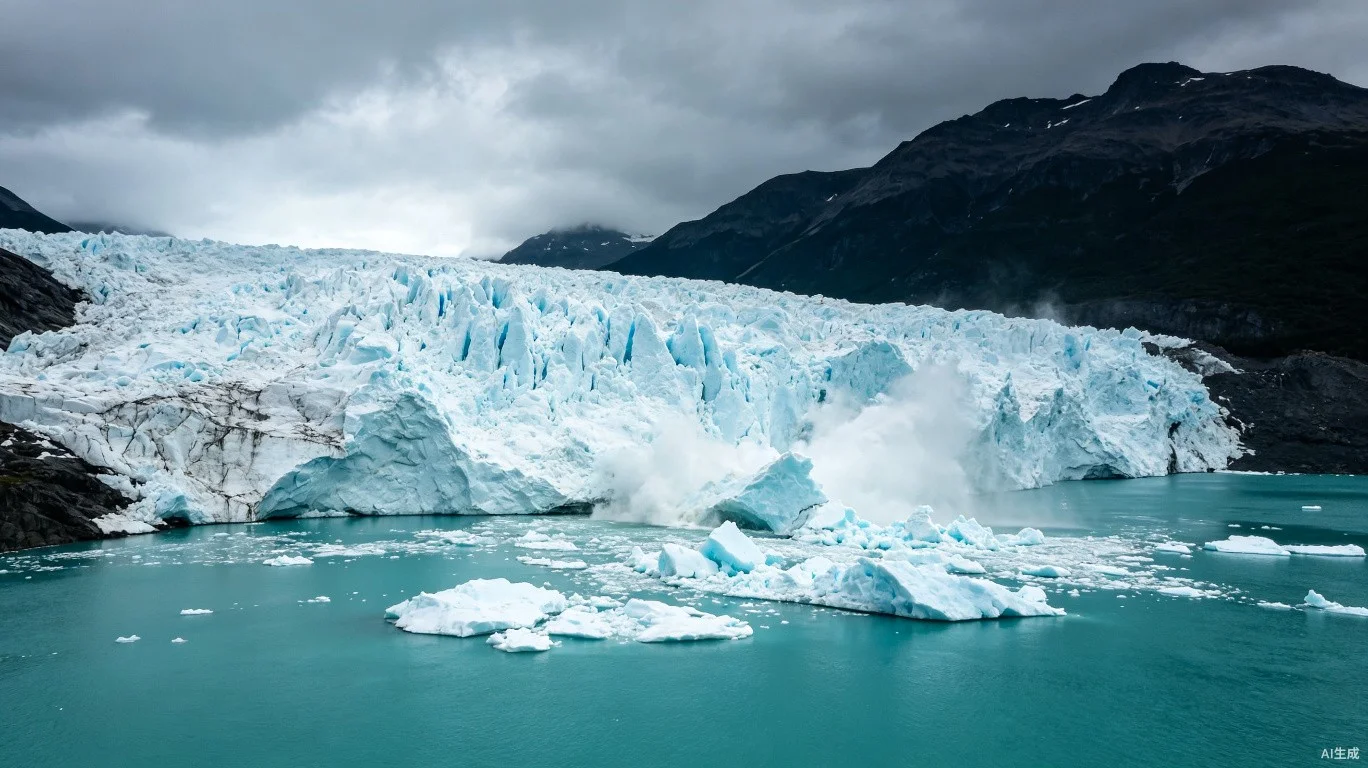
Glaciers are among the most visible and dramatic indicators of climate change, shrinking at unprecedented rates worldwide and threatening water supplies for billions.
Glaciers around the world are losing approximately 267 billion tons of ice per year as of 2025, according to a comprehensive study published in Nature. This rate has accelerated by roughly 30% compared to the early 2000s. The total mass lost since 2000 is equivalent to covering the entire land area of Texas with nearly 8 feet of ice.
The Himalayan glaciers, which feed rivers that supply water to roughly 2 billion people across Asia, could lose up to 80% of their volume by 2100 under high-emission scenarios. Even under the most optimistic climate scenarios, they are projected to lose at least one-third of their ice by the end of the century.
Alaska's glaciers are among the fastest-melting in the world, with some retreating at rates exceeding half a mile per year. Glacier Bay's Muir Glacier has retreated over 31 miles since first documented in the late 1700s. Only 25 of the 50 glaciers originally mapped in Glacier National Park in 1850 remain large enough to be classified as active glaciers today.
Greenland's ice sheet lost an average of 270 billion tons of ice per year between 2002 and 2023, making it the largest single contributor to global sea level rise during this period. In 2019 alone, Greenland lost 532 billion tons of ice, setting a record for annual mass loss. If the entire Greenland ice sheet melted, global sea levels would rise by approximately 24 feet.
Glaciers serve as critical freshwater reservoirs, storing about 69% of the world's freshwater. In regions like the Andes and Central Asia, glacier meltwater provides essential drinking water and irrigation during dry seasons. As glaciers shrink, initially increased melt provides more water, but eventually river flows decline sharply as the glaciers disappear — a phenomenon called "peak water."
Ice cores extracted from glaciers provide an unparalleled climate archive spanning hundreds of thousands of years. Each layer of ice traps air bubbles, dust, and chemical signatures that reveal past temperatures, atmospheric composition, volcanic eruptions, and even ancient pollen. However, as glaciers melt, these irreplaceable climate records are being destroyed faster than scientists can collect them.
Mountain glaciers outside the polar regions are the canaries in the climate coal mine, responding more quickly to temperature changes than ice sheets. The Andes, Alps, and Rockies have already lost over 30% of their glacial area since the mid-20th century. The last remaining glacier in Venezuela — the Humboldt Glacier on Pico Humboldt — was reclassified as an ice field in 2024 after shrinking below the size threshold for glacial classification.
Permafrost thaw, closely linked to glacier retreat, releases previously frozen organic matter that decomposes and emits methane and carbon dioxide — powerful greenhouse gases. The Arctic permafrost contains nearly twice as much carbon as the entire atmosphere. This creates a dangerous feedback loop where warming melts permafrost, releasing more greenhouse gases that accelerate warming, melting even more permafrost.
Antarctica's Thwaites Glacier — ominously nicknamed the "Doomsday Glacier" — is roughly the size of Florida and contains enough ice to raise global sea levels by 2 feet. If it collapses entirely, it could destabilize much of the West Antarctic Ice Sheet, potentially contributing more than 10 feet of sea level rise over centuries. Observations show the glacier is retreating faster than previously predicted.
Glacial meltwater is causing a measurable change in Earth's rotation. The redistribution of water mass from melting glaciers and ice sheets toward the equator is slightly shifting the planet's axis and slowing its rotation, effectively lengthening our days by about 1.3 milliseconds per century — a reminder that climate change operates at truly planetary scales.
Some glaciers, paradoxically, are growing in specific regions. A few glaciers in the Karakoram range of the Himalayas have been stable or advancing, a phenomenon known as the "Karakoram anomaly." Scientists attribute this to increased snowfall in these high-altitude regions, which temporarily offsets warming-driven melting. However, even these glaciers are expected to succumb to rising temperatures as the century progresses.