
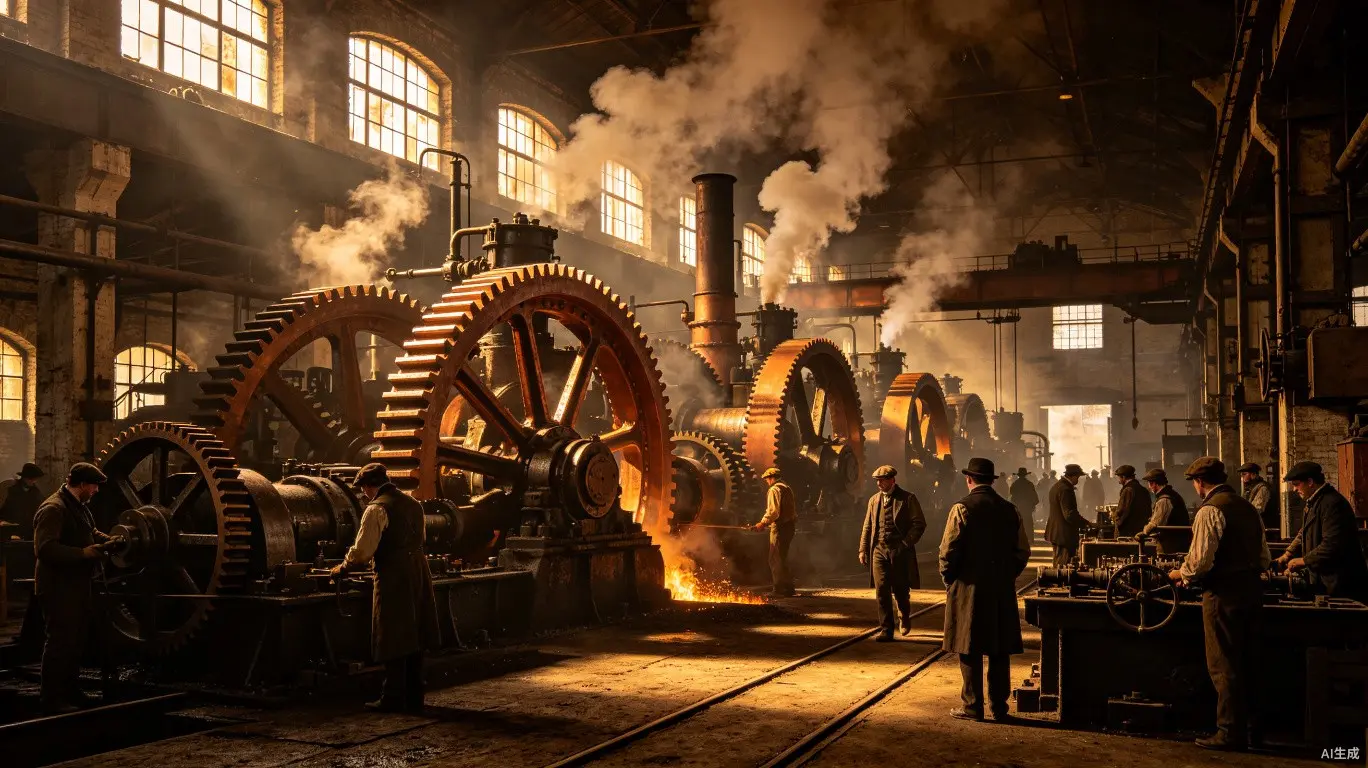
The Industrial Revolution transformed human civilization more dramatically than any other period in history, shifting societies from agricultural economies to industrial powerhouses. Behind the steam engines and factory chimneys lie fascinating hidden stories.
The Industrial Revolution actually began not with steam engines but with water power. The first factories in Britain were textile mills built along fast-flowing rivers, using water wheels to power spinning machines and looms. Richard Arkwright’s Cromford Mill, built in 1771, used water power from the River Derwent and is considered the world’s first true factory.
James Watt did not invent the steam engine — he dramatically improved an existing design. Thomas Newcomen had built atmospheric steam engines for pumping water from mines as early as 1712. Watt’s critical innovation in 1769 was the separate condenser, which prevented energy loss and made steam engines roughly five times more efficient.
Child labor was not an unintended consequence but a deliberate feature of early industrialization. Factory owners preferred children because their small hands could reach into machinery for repairs, they could be paid as little as one-tenth of adult wages, and they were considered more docile and easier to discipline. By 1821, roughly half of British factory workers were under the age of 16.
The term “Luddite” derives from Ned Ludd, an allegedly mythical apprentice weaver who smashed two stocking frames in 1779. The Luddite movement of 1811-1816 was not simply anti-technology. Skilled textile workers were protesting the use of unskilled labor to operate machines that produced inferior goods while destroying their livelihoods and craft traditions built over generations.
The Crystal Palace, built for the 1851 Great Exhibition in London, was a revolutionary structure made entirely of prefabricated cast iron and glass. At 564 meters long and 39 meters high, it enclosed over 92,000 square meters of exhibition space and was constructed in just nine months, demonstrating the architectural potential of industrial materials.
The railway boom of the 1840s was one of history’s greatest speculative bubbles. In Britain alone, Parliament authorized over 9,000 miles of new railway lines in 1845-1846, and railway shares soared to unsustainable heights. When the bubble burst in 1846, it wiped out the savings of thousands of middle-class investors, including Charles Darwin, who lost heavily.
Communist theory was directly inspired by the Industrial Revolution. Karl Marx and Friedrich Engels wrote the Communist Manifesto in 1848 after observing the appalling conditions of industrial workers in Manchester. Engels’ earlier work documented 15-hour workdays, child labor, and slum housing that shocked middle-class readers.
The Industrial Revolution dramatically changed human physiology. Average height in industrial cities actually declined during the early 1800s as poor nutrition, pollution, and disease took their toll. British army recruits from industrial Manchester were on average 4 inches (10 cm) shorter than recruits from agricultural regions.
Tea played a crucial role in the Industrial Revolution. The switch from beer to tea as the British working-class drink of choice improved public health because boiling water for tea killed waterborne pathogens. The mild caffeine stimulation helped factory workers maintain alertness during 12-14 hour shifts without the impairment caused by alcohol.
The Industrial Revolution created entirely new diseases. “Phossy jaw” (phosphorus necrosis) afflicted match factory workers who absorbed white phosphorus through their teeth, causing the jawbone to rot and glow in the dark. This horrifying condition led to the first bans on white phosphorus in manufacturing in the early 1900s.
Women were the majority workforce in early textile factories, fundamentally changing gender roles. For the first time in history, large numbers of women earned independent wages, gaining a degree of financial autonomy previously unavailable. This economic independence planted seeds for the women’s suffrage movement.
The environmental consequences were visible almost immediately. By the 1850s, the River Thames in London was so polluted with industrial waste and raw sewage that it emitted a stench so powerful it became known as the Great Stink of 1858, leading directly to the creation of London’s modern sewer system.