
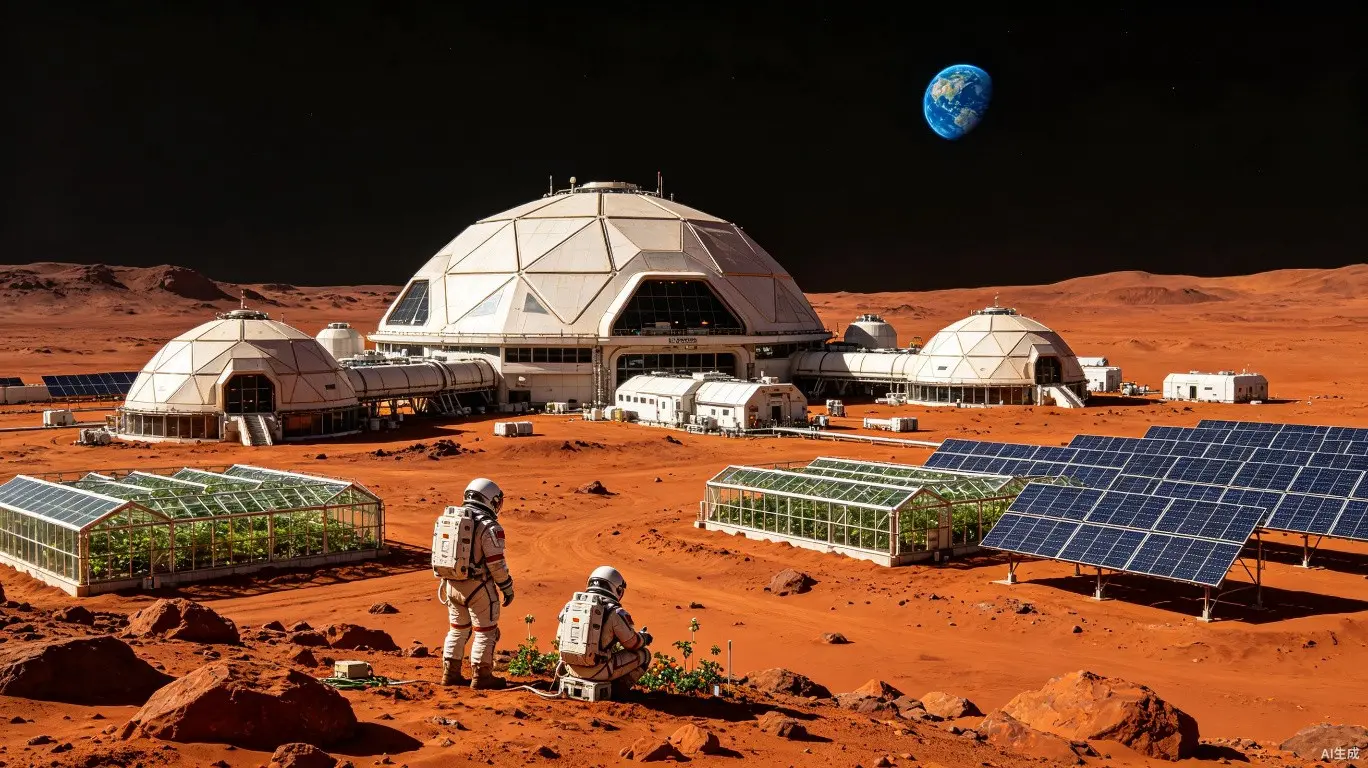
Establishing a permanent human presence on Mars is one of the most ambitious undertakings in human history. From SpaceX’s Starship to NASA’s Artemis program, governments and private companies are racing to turn this science fiction dream into reality.
SpaceX’s Starship, the largest and most powerful rocket ever built, is central to Elon Musk’s vision of establishing a self-sustaining city on Mars with a population of one million people by 2050. The fully reusable spacecraft stands 121 meters tall and can carry up to 100 passengers or 150 tons of cargo to Mars during favorable launch windows.
The journey to Mars takes approximately six to nine months depending on planetary alignment and propulsion technology. Optimal launch windows occur roughly every 26 months when Earth and Mars are closest in their orbits. Any Mars colonization effort must work within these windows, making the logistics of resupply missions critically important.
Mars has only about 38% of Earth’s surface gravity, which poses serious health challenges for long-term human habitation. Prolonged exposure to reduced gravity causes bone density loss of approximately 1-2% per month, muscle atrophy, cardiovascular deconditioning, and fluid shifts that can affect vision.
Radiation is arguably the greatest threat to Mars colonists. Unlike Earth, Mars has no global magnetic field and only a thin atmosphere, exposing the surface to galactic cosmic rays and solar particle events. The radiation dose during a round-trip Mars mission is estimated at 0.6 to 1 sievert, increasing lifetime cancer risk by 3-5%.
Mars has vast reserves of water ice. The Mars Reconnaissance Orbiter has identified subsurface ice deposits in mid-latitude regions that are up to 100 meters thick in places. The polar ice caps contain enough water ice to cover the entire planet in a layer roughly 35 meters deep if melted. This water can be used for drinking, growing food, and producing rocket fuel.
In-Situ Resource Utilization (ISRU) is the key to sustainable Mars colonization. NASA’s MOXIE experiment aboard the Perseverance rover successfully demonstrated oxygen production from Mars’ carbon dioxide-rich atmosphere in 2021, generating about 6 grams of oxygen per hour. A scaled-up version could produce breathing oxygen and rocket oxidizer.
The first Mars habitats will likely be constructed using 3D printing technology with Martian regolith. NASA’s 3D-Printed Habitat Challenge produced designs for structures that could be built autonomously before humans arrive, using Martian soil mixed with binding agents to create durable building materials similar to concrete.
Growing food on Mars presents unique challenges. Martian soil contains toxic perchlorates that must be removed before crops can grow, and the reduced sunlight (about 44% of Earth’s intensity) necessitates supplemental lighting. The EDEN ISS greenhouse demonstrated that vegetables can be grown in simulated space conditions, producing over 250 kilograms of food in a single season.
SpaceX has conducted multiple Starship test flights, with the vehicle achieving orbital velocity for the first time in 2024. The company plans an uncrewed cargo mission to Mars during the 2026 or 2028 launch window, followed by a crewed mission as early as 2028-2029, though these timelines depend on successful orbital refueling technology.
NASA’s long-term Mars plans are built around the Artemis program, which aims to establish a sustainable presence on the Moon first as a proving ground. The Gateway space station in lunar orbit will serve as a staging point, and NASA targets the late 2030s for its first crewed Mars mission.
The psychological challenges of Mars colonization cannot be underestimated. Early colonists will live in confined spaces with limited contact with Earth, experiencing communication delays of 4 to 24 minutes each way. Crew selection, habitat design promoting psychological well-being, and robust communication protocols will be essential.
Terraforming Mars would take centuries or millennia and may prove impractical. The planet lacks sufficient carbon dioxide to create a thick Earth-like atmosphere through warming alone. Even with advanced technology, terraforming would require importing massive amounts of gases or redirecting comets, making planetary-scale engineering the ultimate long-term challenge.