
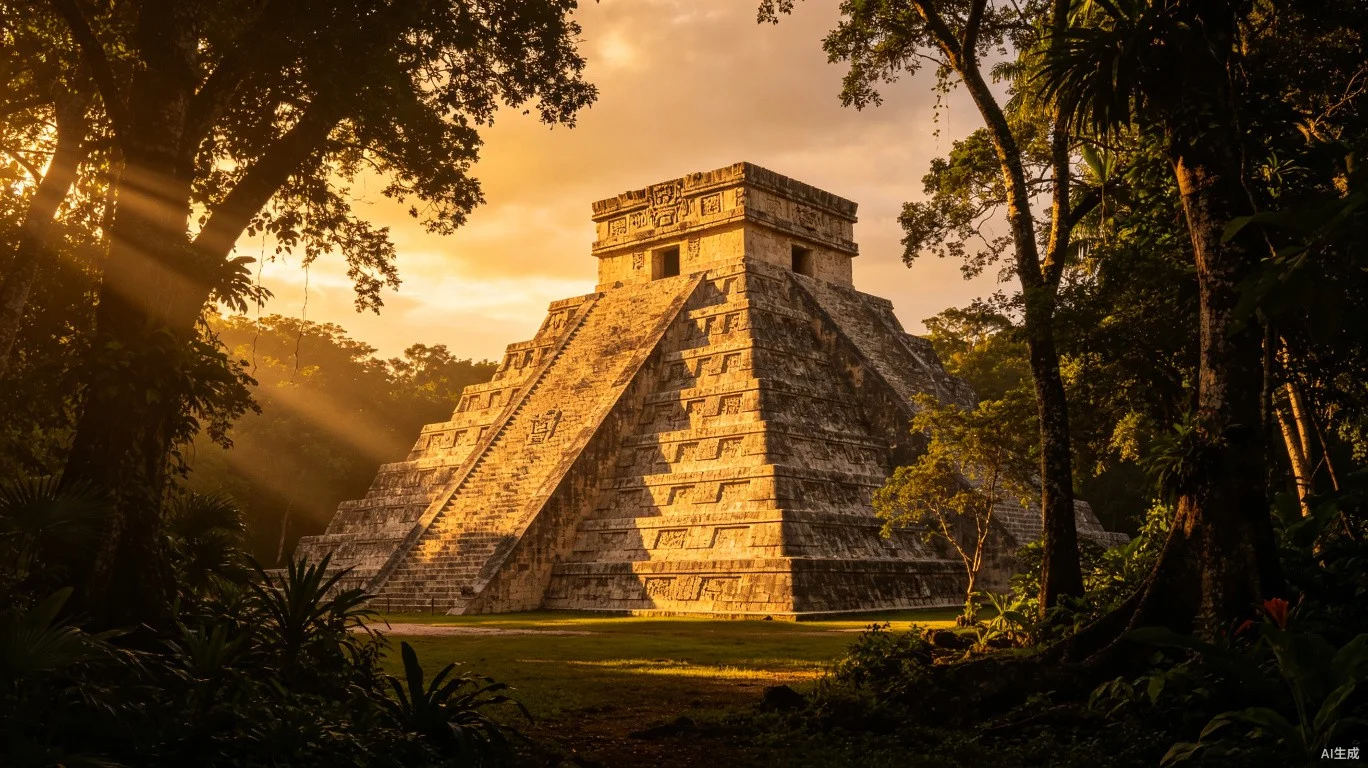
The Mayan civilization built soaring pyramids, developed sophisticated mathematics and astronomy, and created the most advanced writing system in the pre-Columbian Americas.
The Maya civilization flourished in present-day Mexico, Guatemala, Belize, Honduras, and El Salvador for over 3,000 years, reaching its peak during the Classic Period (250-900 CE). At its height, the Maya region supported an estimated population of 10-15 million people living in dozens of city-states connected by trade routes, shared culture, and frequent warfare.
The Maya developed the only fully developed writing system in the pre-Columbian Americas, using over 800 hieroglyphic signs. The script combined logograms (symbols representing whole words) with syllabic glyphs. Spanish conquistadors and priests burned nearly all Maya codices in the 16th century, but the three surviving codices and thousands of stone inscriptions have revealed extraordinary details about Maya history and beliefs.
The Maya independently invented the concept of zero as a placeholder, centuries before it appeared in European mathematics. Their vigesimal (base-20) number system allowed them to calculate dates millions of years into the past and future. Maya astronomers tracked Venus's 584-day cycle with an error of just two hours over 500 years, an accuracy unmatched by any other ancient civilization.
The famous Maya calendar was not one but several interlocking cycles. The 260-day Tzolk'in ritual calendar and the 365-day Haab' solar calendar combined to form the 52-year Calendar Round. Beyond this was the Long Count calendar, which tracked time from a mythological creation date in 3114 BCE. Contrary to popular belief, the Maya never predicted the world would end in 2012 — that date simply marked the end of a 5,125-year Long Count cycle.
Chichen Itza's famous El Castillo pyramid is a precisely engineered astronomical observatory. During the spring and autumn equinoxes, the setting sun casts a shadow that creates the illusion of a serpent slithering down the pyramid's northern staircase. The pyramid has 365 steps — one for each day of the solar year — and its nine terraces represent the nine levels of the Maya underworld.
The Maya played the Mesoamerican ballgame, one of the oldest known team sports in the world, dating back to at least 1400 BCE. Players used their hips, thighs, and forearms to keep a solid rubber ball weighing up to 9 pounds in play on a stone court. The game held profound religious significance — the ball's movement represented the sun's journey through the underworld — and large ball courts have been found at every major Maya site.
The collapse of Classic Maya civilization around 900 CE was not a single catastrophic event but a complex process involving drought, overpopulation, deforestation, soil degradation, warfare, and political instability. Paleoclimate records from lake sediments reveal that the Maya region experienced the most severe droughts in 7,000 years precisely during the Terminal Classic collapse period.
Lidar (Light Detection and Ranging) technology has revolutionized Maya archaeology since 2018. Airborne lidar surveys can see through dense jungle canopy to reveal ancient structures, roads, and agricultural terraces hidden for centuries. A 2018 survey of northern Guatemala revealed over 60,000 previously unknown Maya structures, including massive fortifications, elevated highways, and sophisticated irrigation systems, suggesting a population of 10-15 million.
The Maya built one of the world's most sophisticated ancient water management systems. At Tikal, a city of up to 90,000 inhabitants, the Maya constructed large reservoirs that collected and stored rainwater for the dry season. The largest reservoir at Tikal held over 25 million gallons. These systems sustained large urban populations for centuries despite having no natural rivers or lakes nearby.
Maya achievements in art and architecture rivaled any civilization of their era. The Temple of the Great Jaguar at Tikal rises 154 feet above the jungle floor. The stucco facades, painted murals, and carved stone monuments found throughout Maya cities display extraordinary artistic sophistication. Bonampak's Temple of the Murals contains the finest surviving Maya wall paintings, depicting court ceremonies, warfare, and ritual bloodletting in vivid detail.
Contrary to earlier scholarly assumptions, Maya civilization did not disappear after the Classic collapse. Maya people and culture persisted through the Postclassic period (900-1524 CE), with major cities like Chichen Itza and Mayapan continuing to flourish. Today, over 6 million Maya people live in the same region their ancestors inhabited, preserving many traditional languages, agricultural practices, and cultural traditions.
One of the greatest mysteries of Maya civilization is the purpose of their underground cave systems, known as cenotes. The Maya considered cenotes sacred portals to Xibalba, the underworld. Archaeological excavations in cenotes have revealed thousands of offerings including gold, jade, pottery, and human remains. The Sacred Cenote at Chichen Itza alone contained the remains of over 200 individuals, some of whom appear to have been sacrificed to the rain god Chaac.