
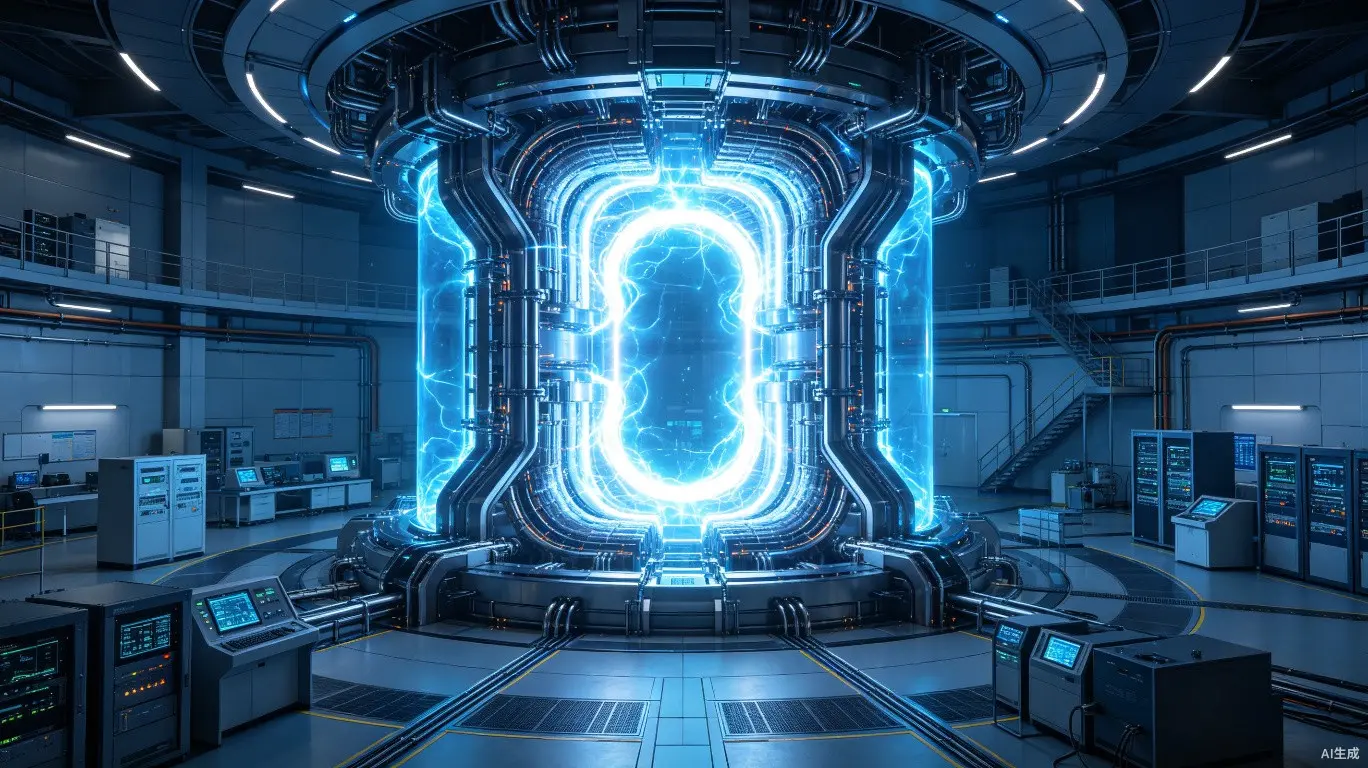
Nuclear fusion, the process that powers the stars, promises virtually limitless clean energy without the long-lived radioactive waste of fission. After decades of slow progress, recent breakthroughs are bringing commercial fusion power closer than ever before.
In December 2022, scientists at the National Ignition Facility achieved a historic milestone: for the first time, a fusion reaction produced more energy than was delivered by the lasers. The experiment generated 3.15 megajoules of fusion energy from 2.05 megajoules of laser input, a net energy gain of about 1.5 times. This was repeated and improved upon multiple times through 2025, with the record reaching 5.5 megajoules.
There are two main approaches to achieving controlled fusion on Earth: magnetic confinement, which uses powerful magnetic fields to contain superheated plasma in a donut-shaped tokamak, and inertial confinement, which uses lasers or particle beams to compress and heat tiny fuel pellets to extreme densities and temperatures. Both approaches have produced fusion reactions, but achieving sustained net energy gain remains the critical challenge.
The ITER project in southern France, the world’s largest magnetic confinement fusion experiment, involves 35 nations collaborating to build a tokamak that will produce 500 megawatts of fusion power from 50 megawatts of input heating power. The first plasma operations are targeted for the mid-2030s, with full deuterium-tritium fusion experiments planned for 2039.
Private fusion companies have attracted over $6 billion in investment as of 2025, with more than 40 startups pursuing various fusion approaches. Notable companies include Commonwealth Fusion Systems, which is building the SPARC tokamak using revolutionary high-temperature superconducting magnets, and Helion Energy, which uses a field-reversed configuration approach.
Commonwealth Fusion Systems successfully tested a 20-tesla high-temperature superconducting magnet in 2021, a world record that enables much smaller, cheaper tokamaks. Their magnet technology allows fusion reactors to be built at a fraction of the size and cost of ITER-scale machines, potentially accelerating the timeline to commercial fusion power to the early 2030s.
The fusion fuel deuterium can be extracted from ordinary seawater, and there is enough deuterium in the oceans to power human civilization for millions of years. Tritium, the other fuel component, is rare in nature but can be bred from lithium within the fusion reactor itself, making the fuel supply effectively inexhaustible.
Unlike nuclear fission, fusion reactors cannot melt down. If any disturbance occurs in the plasma, the reaction simply stops because the extreme conditions required for fusion cannot be maintained. Additionally, fusion produces no long-lived high-level radioactive waste, and the primary radioactive byproducts have half-lives of decades rather than thousands of years.
The Joint European Torus (JET) in the UK set a sustained fusion energy record in 2021-2022, producing 59 megajoules of fusion energy over a five-second pulse. This experiment provided crucial data for ITER and demonstrated that sustained fusion energy production is feasible with current technology, even if not yet at net energy gain levels.
In 2025, China’s Experimental Advanced Superconducting Tokamak (EAST) sustained a plasma temperature of 120 million degrees Celsius for 101 seconds and reached 160 million degrees for 20 seconds. These plasma duration records demonstrate progress toward steady-state operation, which is essential for a practical fusion power plant.
The temperature required for deuterium-tritium fusion is approximately 150 million degrees Celsius, about ten times hotter than the core of the Sun. At these temperatures, atoms are stripped of their electrons, forming a plasma where negatively charged electrons and positively charged nuclei move independently.
A major engineering challenge for fusion reactors is the development of materials that can withstand the intense neutron bombardment. The first wall of a fusion reactor will experience neutron fluxes that can embrittle and weaken structural materials over time, requiring advanced materials like reduced-activation ferritic-martensitic steels and silicon carbide composites.
Several fusion companies are targeting demonstration reactors by the early 2030s, with Commonwealth Fusion Systems aiming to have SPARC operational by 2028 and already designing its follow-on commercial reactor. Helion Energy has signed a power purchase agreement with Microsoft to deliver fusion-generated electricity by 2028, though many experts consider this timeline optimistic.