
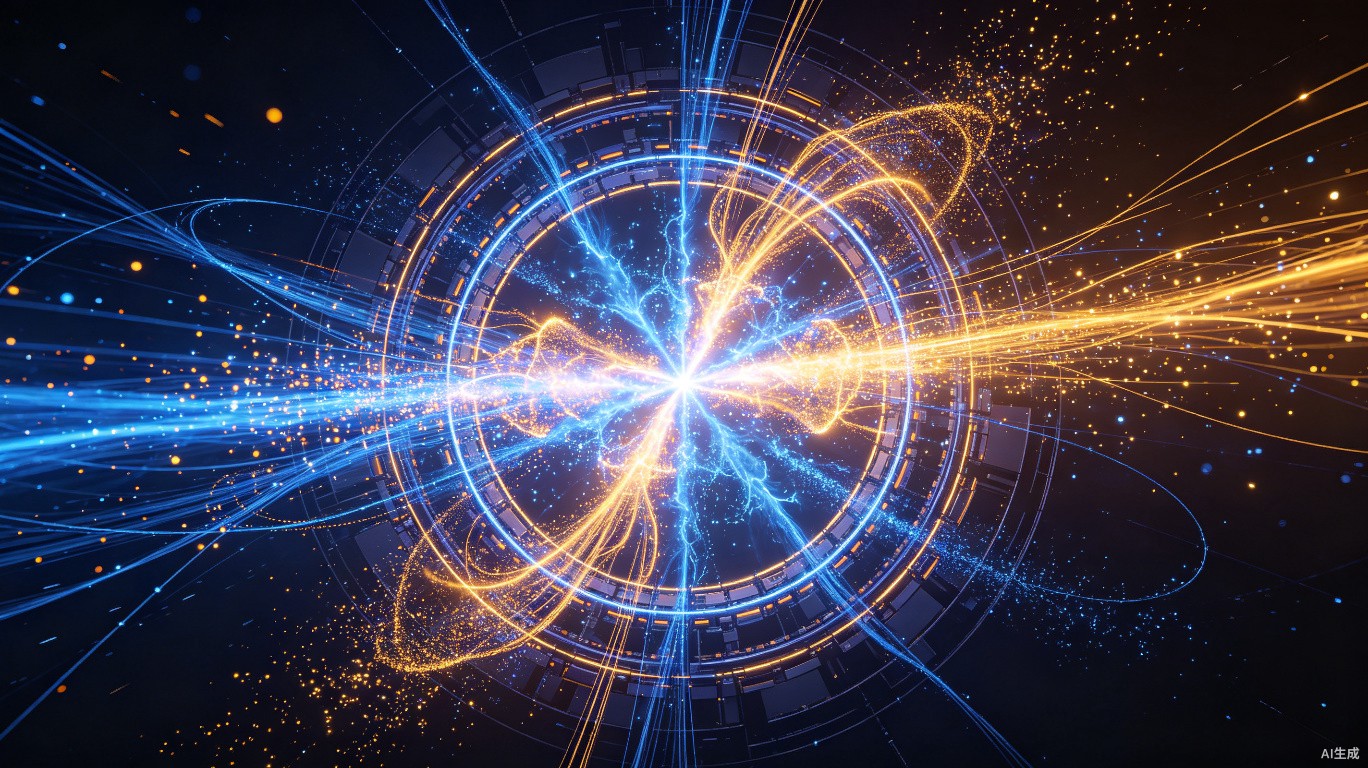
Particle physics explores the most fundamental building blocks of matter and the forces that govern their interactions. From subatomic particles that exist for billionths of a second to experiments that recreate conditions moments after the Big Bang, this field continues to challenge and expand our understanding of the universe at its most basic level.
The Large Hadron Collider at CERN is the world's largest and most powerful particle accelerator, with a circumference of 27 kilometers buried up to 175 meters underground. Its superconducting magnets are cooled to minus 271.3 degrees Celsius — colder than outer space — making it the coldest place in the known universe.
Neutrinos are among the most abundant particles in the universe, yet they interact so weakly with matter that about 100 trillion pass through your body every second without leaving a trace. Detecting them requires enormous tanks of ultrapure water or ice buried deep underground to shield from other cosmic radiation.
The Higgs boson, confirmed in 2012, is the particle responsible for giving mass to other fundamental particles. Its existence was predicted nearly 50 years earlier by Peter Higgs and others, and its discovery required analyzing data from over 600 trillion proton-proton collisions at the Large Hadron Collider.
Antimatter is composed of antiparticles that have the same mass as regular particles but opposite charge. A teaspoon of antimatter would release energy equivalent to about 10 million tons of TNT if it came into contact with matter, yet producing even a billionth of a gram remains extraordinarily difficult and expensive.
Muons are heavier cousins of electrons that exist for just 2.2 microseconds before decaying. The anomalous magnetic moment of the muon, measured at Fermilab, has shown tantalizing discrepancies from theoretical predictions, potentially hinting at undiscovered particles or a fifth fundamental force of nature.
Quantum entanglement allows particles to remain connected such that measuring the state of one instantly determines the state of its partner, regardless of distance. Einstein called this "spooky action at a distance," but experiments have repeatedly confirmed that entanglement is a real and fundamental feature of quantum mechanics.
Quarks are never found in isolation — they are always bound together inside protons, neutrons, and other hadron particles. If you try to pull quarks apart, the energy required becomes so enormous that new quark-antiquark pairs are created from the vacuum, immediately forming new particles.
The IceCube Neutrino Observatory at the South Pole uses a cubic kilometer of Antarctic ice as its detector. Thousands of optical sensors buried deep in the ice detect the faint flashes of blue light produced when neutrinos occasionally interact with ice molecules.
The top quark is the heaviest known fundamental particle, about 184 times the mass of a proton — roughly equivalent to the mass of a gold atom. Its existence was predicted in 1973 but not confirmed until 1995 at Fermilab's Tevatron accelerator because producing such a massive particle required unprecedented collision energies.
W bosons mediate the weak nuclear force responsible for radioactive decay. In 2022, an ultra-precise measurement of the W boson's mass at Fermilab revealed a value significantly different from Standard Model predictions, sparking intense debate and reevaluation of our most successful theory of particle physics.
Strange quark matter may be the most stable form of matter in the universe according to some theoretical models. If true, ordinary atomic nuclei could theoretically convert into strange matter upon contact with a strangelet, a hypothetical particle of strange quark matter — though no such particle has ever been observed.
Particle physicists are actively searching for evidence of supersymmetry, a theory proposing that every known particle has a heavier "superpartner." If confirmed, supersymmetry could explain dark matter, unify the fundamental forces, and solve several long-standing puzzles about the mass of the Higgs boson.