
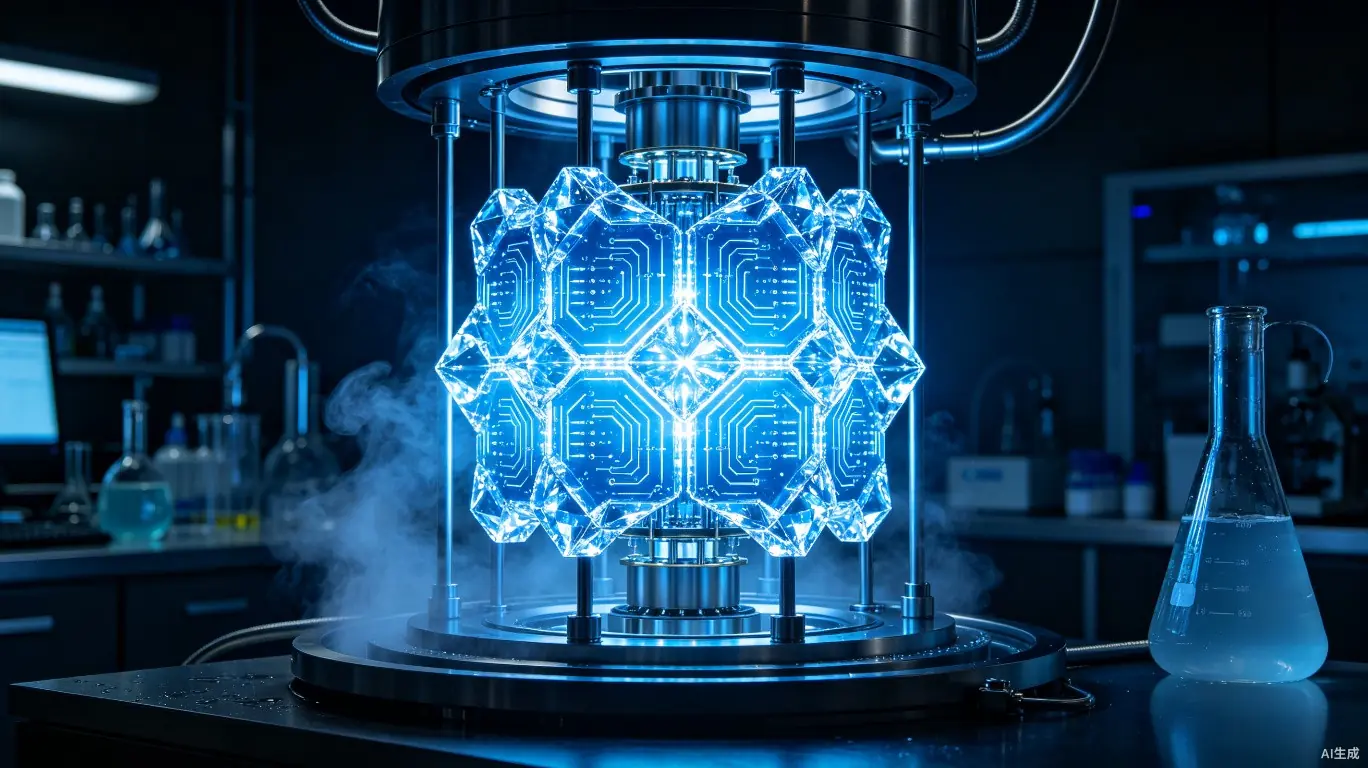
Quantum computing harnesses the principles of quantum mechanics to solve problems that would take classical computers thousands of years. Recent breakthroughs in hardware, error correction, and algorithm development are bringing practical quantum advantage closer than ever before.
In December 2025, Google's Willow quantum processor achieved a landmark result: solving a random circuit sampling problem in under 5 minutes that would take the world's most powerful classical supercomputer approximately 10 septillion years. This marked the first conclusive demonstration of quantum computational advantage on a programmable superconducting platform with real-time error correction.
Quantum error correction took a historic leap forward in 2024-2025 when multiple research teams demonstrated that increasing the number of physical qubits in a logical qubit actually reduces the error rate exponentially. Google's Willow chip showed error rates dropping by a factor of 2.14 each time the code distance increased from 3 to 5 to 7, the first clear evidence of operating below the surface code threshold.
IBM's Quantum Heron processor, introduced in late 2024, brought 156 qubits with gate fidelities exceeding 99.9%, a dramatic improvement over the previous 127-qubit Eagle processor. The Heron architecture's novel tunable coupler design allowed qubits to be paired with minimal crosstalk, enabling deeper circuits and more complex quantum algorithms for practical applications in chemistry and optimization.
Neutral atom quantum computing emerged as a serious contender in 2025, with QuEra's Aquila system demonstrating logical qubits built from 280 neutral atoms arranged in reconfigurable arrays using optical tweezers. The technology offers inherent scalability since atoms are identical and can be arranged in three-dimensional configurations, potentially reaching thousands of logical qubits by 2027.
Quantum classical hybrid computing has become the dominant architectural paradigm. In 2025, researchers successfully coupled a 100-qubit quantum processor with a GPU cluster to solve molecular dynamics simulations for drug discovery, splitting the workload so the quantum computer handled electron correlation calculations while classical computers managed the remaining computation — a practical template for near-term quantum utility.
Topological qubits, long pursued by Microsoft's Station Q, remain a tantalizing goal. In 2025, Microsoft announced experimental evidence for Majorana zero modes in indium arsenide-aluminum hybrid nanowires with improved coherence properties. If confirmed and scaled, topological qubits would be inherently protected against certain types of quantum noise, dramatically reducing the overhead needed for error correction.
Quantum networking achieved a significant milestone in 2025 when researchers at Delft University demonstrated a three-node entangled quantum network between cities separated by 50 kilometers. Using nitrogen-vacancy centers in diamond as quantum memory nodes and existing fiber optic infrastructure, the network successfully distributed entanglement across all three nodes simultaneously — a key step toward a future quantum internet.
Photonics-based quantum computing advanced rapidly with Xanadu's Borealis system, which uses squeezed light states and time-domain multiplexing to perform Gaussian boson sampling. By encoding information in pulses of light rather than matter-based qubits, photonic quantum computers can operate at room temperature and integrate naturally with existing fiber optic communication networks.
In 2025, a quantum computer simulated the behavior of a catalyst for nitrogen fixation with chemical accuracy for the first time. The simulation modeled the electronic structure of the iron-molybdenum cofactor — the active site of the enzyme nitrogenase — using just 60 logical qubits, a problem that had resisted classical computational approaches for decades due to strong electron correlation effects.
Post-quantum cryptography standardization reached a critical juncture when NIST finalized the first set of quantum-resistant cryptographic algorithms in 2024-2025. CRYSTALS-Kyber for key encapsulation and CRYSTALS-Dilithium for digital signatures are now being deployed across government and financial systems worldwide, preparing for the day when sufficiently powerful quantum computers can break current RSA and elliptic curve encryption.
Quantum machine learning is showing promising results in specialized domains. In 2025, a hybrid quantum-classical neural network trained on a trapped-ion quantum computer outperformed classical deep learning models on specific molecular property prediction tasks, though general-purpose quantum advantage in machine learning remains an open question requiring improved qubit counts and coherence times.
China's quantum computing efforts intensified dramatically, with the launch of the Tianyan-504 superconducting quantum processor featuring 504 qubits in early 2026. The system employs a novel 3D integration architecture that stacks qubit chips vertically with through-silicon vias for interconnects, representing a new approach to scaling beyond the planar chip designs used by most competitors.