
The Renaissance, spanning roughly the 14th through 17th centuries, marked one of the most profound shifts in human creativity and intellectual pursuit. Beginning in Italy and spreading across Europe, this period revolutionized how artists perceived and portrayed the world, laying the groundwork for modern artistic expression.
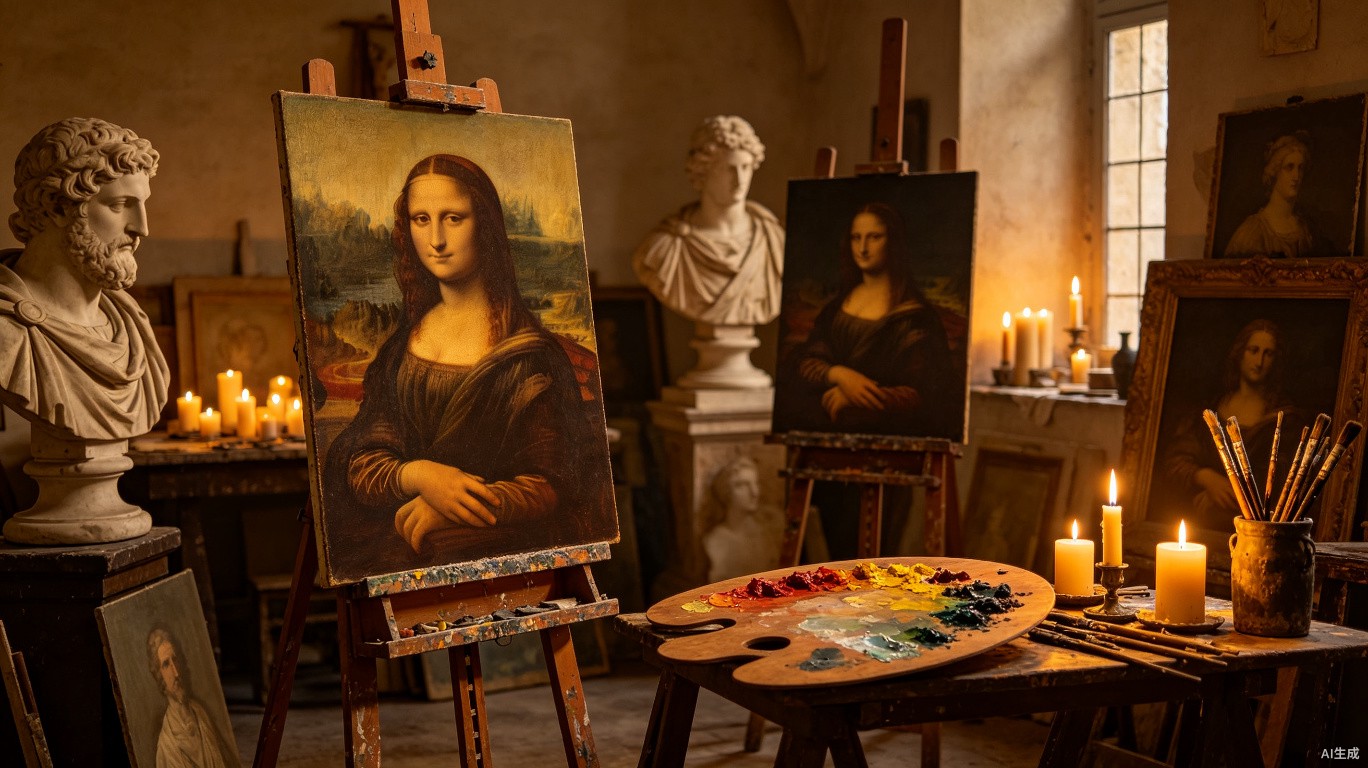
Leonardo da Vinci's Mona Lisa was painted over approximately 16 years and contains no visible brushstrokes — a technique called sfumato, meaning "smoky." Da Vinci achieved this by applying dozens of ultra-thin glazes of oil paint, with some layers thinner than a human hair, creating an almost photographic softness.
Michelangelo considered himself a sculptor, not a painter, and initially refused the commission to paint the Sistine Chapel ceiling. He worked standing on scaffolding of his own design for four years, painting over 300 figures across 500 square meters — all while writing poetry complaining about the physical torment of the task.
Linear perspective was mathematically codified by Filippo Brunelleschi in the early 1400s after he conducted a famous experiment using a mirror and a painted panel of the Florence Baptistery. This discovery allowed artists to create the illusion of three-dimensional depth on flat surfaces with unprecedented accuracy, fundamentally changing Western art.
The technique of oil painting spread from Northern Europe to Italy during the Renaissance, replacing the earlier tempera method that used egg yolk as a binder. Oil paint dried more slowly, allowing artists to blend colors seamlessly, build translucent layers, and achieve richer, more luminous effects than ever before.
Raphael, one of the great masters of the High Renaissance, died at the age of only 37 yet left behind an enormous body of work including the Vatican's Stanze rooms and numerous Madonnas. His funeral at the Pantheon in Rome was one of the largest the city had ever witnessed, and he was buried at his own request next to his unfinished painting Transfiguration.
Jan van Eyck, a Flemish painter, perfected the use of oil paint and was among the first to sign his work prominently. His Arnolfini Portrait of 1434 includes a convex mirror in the background that reflects two additional figures entering the room — one of whom may be van Eyck himself — with the inscription "Jan van Eyck was here."
Donatello's bronze statue of David, completed around 1440, was the first free-standing nude male sculpture since antiquity. Its sensuality and naturalism broke sharply with medieval conventions and signaled the Renaissance embrace of classical ideals of human beauty and individualism.
The art patronage system that fueled the Renaissance was dominated by the Medici family of Florence. Cosimo de' Medici alone spent the equivalent of roughly 500 million modern dollars on art and architecture, transforming Florence into what historians call the cradle of the Renaissance.
Albrecht Durer, the greatest German Renaissance artist, revolutionized printmaking by elevating woodcuts and engravings to the status of fine art. His prints spread Renaissance ideas across Europe rapidly and affordably, functioning as an early form of mass communication — his engraving of a rhinoceros, drawn entirely from a written description, remained the standard image of the animal for 200 years.
Botticelli's Birth of Venus broke both artistic and social conventions by depicting a pagan goddess as the central subject of a large-scale painting and using the female nude in a secular context. The painting was almost certainly commissioned for a private villa, as displaying such a work publicly would have been scandalous in 1480s Florence.
Titian revolutionized the use of color in painting, employing a technique called colorito that prioritized vibrant hues over the precise drawing favored by Florentine artists. His loose, expressive brushwork in his later works was so radical that some contemporaries believed his eyesight was failing — when in fact he was pioneering a style that would influence artists for centuries.
The competition for the bronze doors of the Florence Baptistery in 1401 is often cited as the event that launched the Renaissance. Lorenzo Ghiberti won the commission over Filippo Brunelleschi, and his finished doors were so magnificent that Michelangelo later dubbed them the "Gates of Paradise."
Art historians have identified at least 24 surviving paintings by women artists of the Renaissance, with Sofonisba Anguissola being the most celebrated. She served as court painter to King Philip II of Spain and developed innovative informal portrait styles that influenced male contemporaries, yet her works were frequently misattributed to male painters for centuries.