
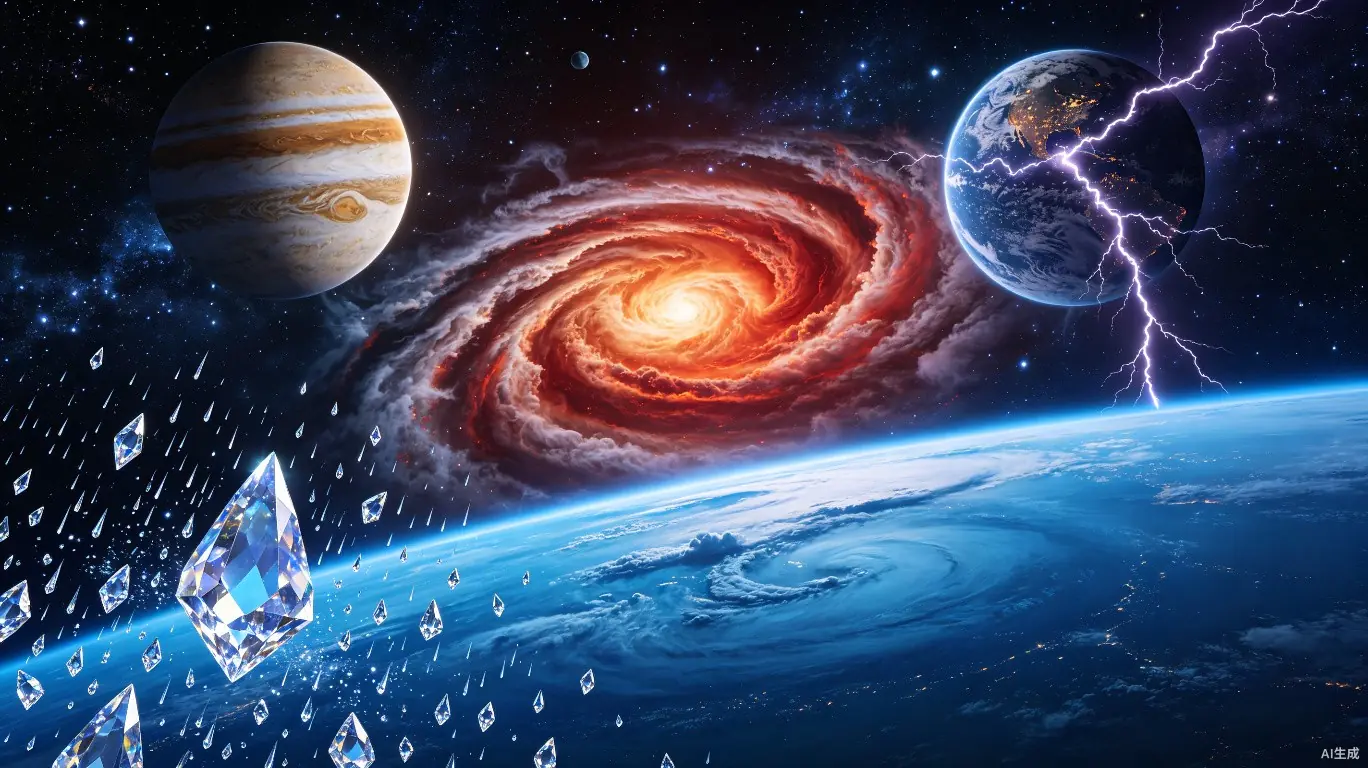
Earth's hurricanes and blizzards pale in comparison to the weather phenomena found throughout our solar system. From methane rain on Titan to diamond storms on Neptune and supersonic winds on exoplanets, cosmic weather is far stranger and more violent than anything we experience at home.
Jupiter's Great Red Spot is a persistent anticyclonic storm that has raged for at least 358 years since astronomers first observed it in 1665. The storm is larger than Earth itself, spanning about 16,000 kilometers in diameter, with wind speeds exceeding 430 kilometers per hour at its periphery. Despite shrinking in recent decades, it remains the largest known storm in the solar system.
Venus experiences a runaway greenhouse effect that makes it the hottest planet in the solar system, with surface temperatures averaging 462 degrees Celsius — hot enough to melt lead. Its atmosphere of carbon dioxide is 90 times denser than Earth's, and sulfuric acid clouds rain down at altitudes where it is too hot for the acid droplets to reach the surface as liquid, evaporating instead into a perpetual corrosive haze.
Neptune hosts the fastest winds in the solar system, with speeds recorded at 2,100 kilometers per hour by the Voyager 2 spacecraft in 1989. These supersonic winds, far faster than Earth's most powerful tornadoes, remain somewhat mysterious since Neptune receives only 0.1% of Earth's solar energy. Scientists believe the planet's internal heat, combined with low atmospheric friction, enables these astonishing wind speeds.
Saturn's moon Titan features a complete methane cycle analogous to Earth's water cycle, with methane clouds, methane rain, methane rivers, and expansive methane lakes concentrated near the poles. Titan is the only known world in the solar system besides Earth with stable liquid on its surface, though at minus 179 degrees Celsius, the rain is liquid methane rather than water.
Mars experiences planet-wide dust storms that can envelop the entire globe for months at a time. In 2018, a global dust storm silenced NASA's Opportunity rover permanently by coating its solar panels in a thick layer of fine dust. These storms generate electrostatic discharges and can lift billions of tons of dust into the thin Martian atmosphere, fundamentally altering the planet's climate patterns.
Diamond rain likely falls deep within the atmospheres of Uranus and Neptune, where extreme pressures break apart methane molecules. The liberated carbon atoms crystallize into diamonds that sink through the planets' mantles, potentially forming vast diamond layers thousands of kilometers below the cloud tops. Laboratory experiments at the SLAC National Accelerator Laboratory in 2017 confirmed this phenomenon is physically possible.
The hexagonal storm at Saturn's north pole is one of the most geometrically perfect features in nature — a six-sided jet stream spanning approximately 30,000 kilometers with a massive hurricane-like vortex at its center. First observed by the Voyager mission and later studied in detail by Cassini, the hexagon has persisted for decades, and its precise geometric shape continues to challenge fully satisfactory explanation by atmospheric physicists.
Io, Jupiter's innermost Galilean moon, is the most volcanically active body in the solar system, with over 400 active volcanoes continuously erupting. Volcanic plumes shoot sulfur dioxide gas up to 500 kilometers into space, and lava temperatures reach 1,600 degrees Celsius. This extreme volcanism is driven by tidal heating from gravitational interactions with Jupiter and its neighboring moons Europa and Ganymede.
Mercury experiences the most extreme temperature swings in the solar system, fluctuating from minus 180 degrees Celsius at night to 430 degrees Celsius during the day — a range of over 600 degrees. A single day on Mercury lasts 176 Earth days, so the surface has plenty of time to both superheat under the Sun and freeze in darkness, making it impossible for any atmosphere to persist.
Lightning on Jupiter is up to 1,000 times more powerful than lightning on Earth, with radio emissions detected by the Juno spacecraft revealing strikes concentrated near Jupiter's poles. Unlike Earth where lightning is driven primarily by water cloud convection, Jovian lightning is generated in ammonia-water cloud layers at greater depths within its turbulent, multi-layered atmosphere.
The ice giant Uranus is tipped on its side with an axial tilt of 98 degrees, causing the most extreme seasonal variations of any planet. Each pole experiences 42 years of continuous sunlight followed by 42 years of complete darkness. During Voyager 2's 1986 flyby, Uranus's southern hemisphere was in full summer, and when the James Webb Space Telescope imaged the planet in 2023, it revealed dramatic polar brightening as the northern hemisphere emerged from decades of winter darkness.
Brown dwarfs, objects straddling the boundary between giant planets and failed stars, can host clouds of molten iron and silicate dust in their upper atmospheres. Observations from the Spitzer Space Telescope and James Webb Space Telescope have revealed weather patterns on these substellar objects, including iron clouds condensing and raining out as the objects cool, creating a kind of metallic weather completely alien to anything in our solar system.