
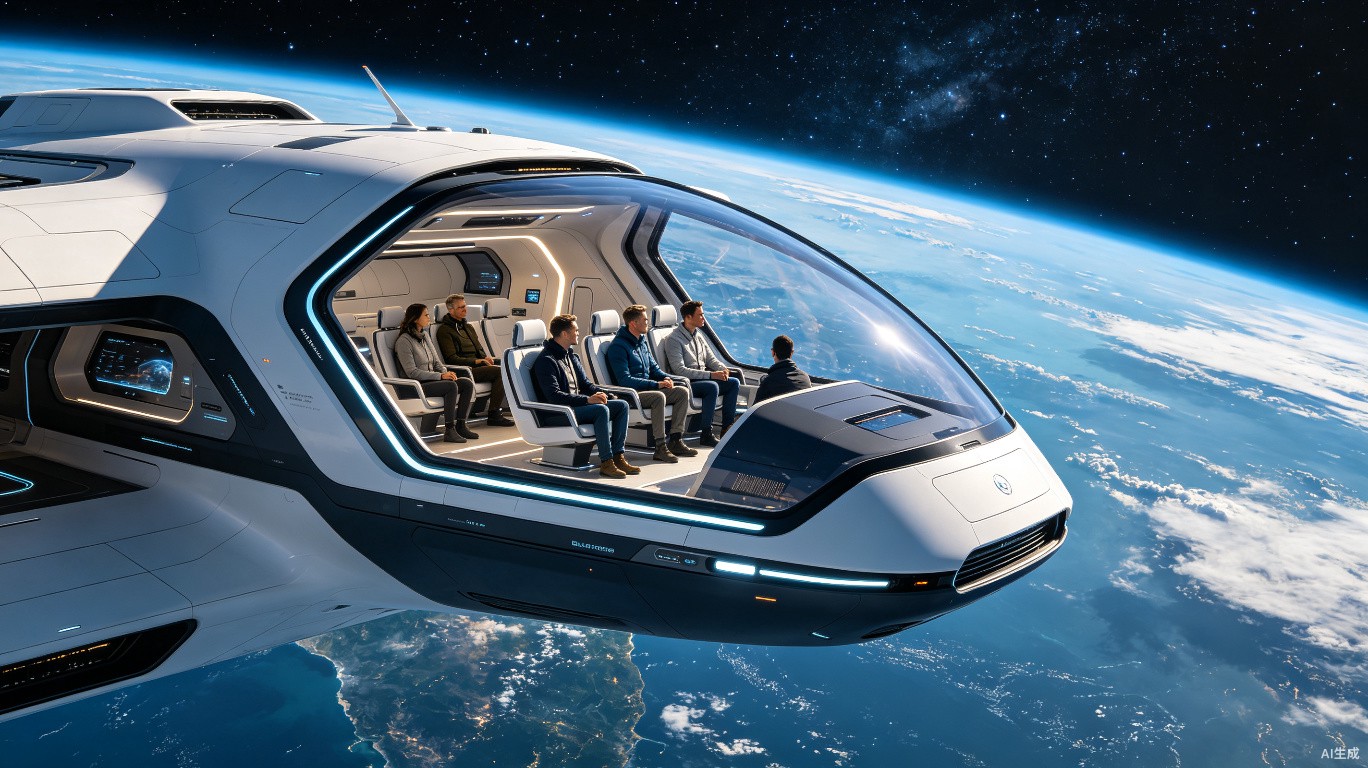
Space tourism has transformed from science fiction into a tangible reality over the past two decades. Private companies are now competing to offer suborbital joyrides, orbital stays, and even planned lunar missions to paying customers, fundamentally reshaping humanity's relationship with space travel.
SpaceX's Crew Dragon became the first private spacecraft to carry NASA astronauts to the International Space Station in 2020. Since then, the vehicle has flown multiple all-private missions, including Inspiration4 in 2021, which sent four civilians into orbit for three days without any professional astronauts aboard.
Blue Origin's New Shepard rocket is designed for suborbital tourism, launching passengers past the Karman line at 100 kilometers altitude for approximately three minutes of weightlessness. The capsule features the largest windows ever flown in space, measuring roughly 1.1 meters tall for panoramic Earth views.
Virgin Galactic's SpaceShipTwo uses a unique air-launch system where a carrier aircraft lifts the spaceship to altitude before release. The craft then ignites its rocket motor to ascend beyond 80 kilometers, allowing passengers to unstrap and float freely during several minutes of microgravity.
The first space tourist was Dennis Tito, an American businessman who paid approximately 20 million dollars to visit the International Space Station aboard a Russian Soyuz spacecraft in 2001. His trip sparked controversy at NASA but ultimately paved the way for the private spaceflight industry.
Axiom Space is developing the world's first commercial space station, with modules planned to attach to the International Space Station before eventually separating to form an independent orbital destination. The company envisions research labs, luxury accommodations, and manufacturing facilities in low Earth orbit.
The cost of reaching orbit has plummeted dramatically thanks to reusable rocket technology. SpaceX's Falcon 9 first-stage boosters have been recovered and reused more than 200 times, reducing launch costs by an estimated 60 percent compared to fully expendable rockets.
Orbital Assembly Corporation has announced plans to build a space hotel called Voyager Station, designed as a rotating wheel structure that would generate artificial gravity. The concept draws directly from the rotating space station ideas popularized by Wernher von Braun and Stanley Kubrick's film 2001: A Space Odyssey.
Space Perspective offers balloon-based space tourism, suspending a pressurized capsule beneath a massive hydrogen balloon for a gentle six-hour journey to 30 kilometers altitude. While not technically reaching space, passengers experience the blackness of space and the curvature of Earth without the intense g-forces of rocket launches.
Russia's Roscosmos has explored filming movies aboard the International Space Station. In 2021, a Russian film crew spent 12 days aboard the station shooting scenes for The Challenge, the first feature film with sequences actually filmed in orbit rather than on sets or in simulated environments.
The environmental impact of space tourism has drawn increasing scrutiny. A single suborbital launch can produce carbon emissions equivalent to a transatlantic flight per passenger, and black carbon particles from rocket engines released into the upper atmosphere may have disproportionate climate effects.
SpaceX's Starship, the largest and most powerful rocket ever built, is designed to carry up to 100 people on missions to the Moon, Mars, and potentially beyond. Its fully reusable design aims to reduce the cost per passenger to a level comparable to a long-haul airline ticket within a few decades.