
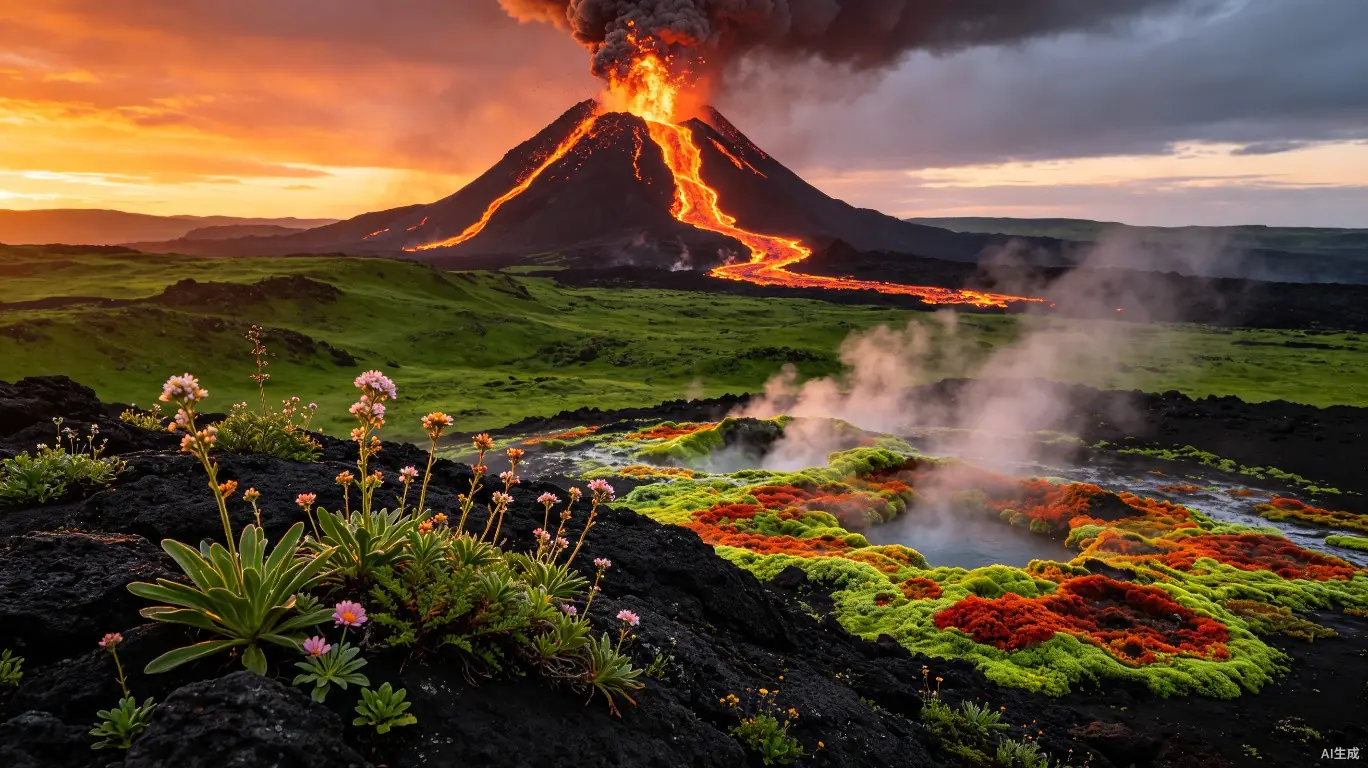
Volcanic landscapes are among the most extreme environments on Earth, yet life finds remarkable ways to flourish in these fiery realms. From microscopic extremophiles to pioneering plants and resilient animals, volcano ecosystems reveal nature's extraordinary capacity for adaptation.
Thermophilic microorganisms thrive in volcanic hot springs at temperatures exceeding 120 degrees Celsius, conditions that would instantly denature most proteins. The bacterium Thermus aquaticus, discovered in a Yellowstone hot spring in 1969, produces the heat-stable DNA polymerase that revolutionized molecular biology by enabling the polymerase chain reaction or PCR technique.
Submarine volcanoes along mid-ocean ridges create hydrothermal vent ecosystems that function entirely without sunlight. Chemosynthetic bacteria convert hydrogen sulfide and methane from volcanic emissions into organic matter, forming the base of a food web that supports tube worms growing over 2 meters long, giant clams, and blind shrimp that thrive in complete darkness.
Kilauea volcano in Hawaii has been continuously erupting since 1983, creating new land from lava flows that cool into barren rock. Within just months, ohia lehua trees begin colonizing these fresh lava fields through tiny seeds carried by wind. Their roots crack the volcanic rock, initiating soil formation and paving the way for entire rainforests to eventually reclaim the landscape.
The Danakil Depression in Ethiopia features Dallol volcano with hydrothermal pools of extreme acidity, reaching pH values below zero — among the most hostile environments on Earth. Yet in 2019, researchers discovered ultra-small bacteria living in these acid-saturated, salt-encrusted pools, organisms that may represent an entirely new branch on the tree of life.
Volcanic soils are among the most fertile on Earth, weathering into mineral-rich substrates ideal for agriculture. Regions surrounding active volcanoes like Mount Etna in Sicily, Mount Merapi in Indonesia, and the volcanic highlands of Costa Rica support exceptionally productive farmland, with soils containing high concentrations of phosphorus, potassium, and trace elements leached from volcanic ash and basalt.
Galapagos land iguanas demonstrate a remarkable adaptation to volcanic environments: they climb down into active volcanic craters to lay their eggs in warm ash and geothermal soil. The consistent underground heat incubates the eggs naturally, and female iguanas make perilous journeys of several kilometers down steep crater walls to access these natural incubators.
Krakatoa, the Indonesian volcano that famously erupted in 1883 with a blast heard over 4,800 kilometers away, provided scientists with an unprecedented natural experiment in ecosystem recovery. Within three years of the eruption that sterilized the island, pioneer species of grasses, ferns, and insects had recolonized, and by 1920 a full tropical forest ecosystem had reestablished itself through natural dispersal mechanisms.
Deep volcanic crust harbors a vast subsurface biosphere that scientists estimate contains up to 20 billion tonnes of microbial carbon — potentially exceeding the biomass of all surface life. These slow-living microbes metabolize hydrogen and other compounds released by water-rock reactions in volcanic basalt, some reproducing only once every thousand years yet collectively comprising a hidden world beneath our feet.
The highest-altitude volcano on Earth, Ojos del Salado on the Chile-Argentina border at 6,893 meters, hosts microbial life in fumarole vents near its summit. These high-altitude extremophiles survive intense UV radiation, extreme aridity, and temperatures that fluctuate wildly between freezing and boiling points within hours, offering insights into how life might persist on Mars.
Volcanic lakes like Costa Rica's Laguna Caliente at Poas volcano feature acidity comparable to battery acid with pH values around zero. Despite these conditions, specialized acidophilic bacteria and archaea thrive in the turquoise-colored, mineral-rich waters, their metabolic processes contributing to the lake's striking coloration and continuous chemical transformations.
Mount St. Helens, following its catastrophic 1980 eruption that obliterated 600 square kilometers of forest, became a living laboratory for ecological succession. Prairie lupines, with their nitrogen-fixing root bacteria, were among the first plants to colonize the devastated pumice plain, and within 40 years the area supported a diverse community of plants, insects, amphibians, birds, and large mammals including elk and mountain lions.
Carbon dioxide emissions from active volcanic vents create localized environments with atmospheric CO2 concentrations many times higher than current global levels. These natural laboratories allow scientists to study how plants and soil microbes respond to elevated CO2, providing crucial data for predicting how terrestrial ecosystems will adapt to climate change over the coming decades.